How to Set up Guest Quarters for Visiting Arthropods
- Many small arthropods can survive quite well in captivity for a short time. The trick is to replicate their habitat as closely as possible and to provide for all of their needs: food, water, shelter; appropriate levels of temperature, light, and moisture. So before capturing any arthropod, observe it carefully in its natural habitat.
- Do some research to identify the arthropod and to find out what it eats. The plant eaters are easier to satisfy, since you will often find them on or near their preferred food. The predators are more difficult, since you will have to capture their prey for them and give it to them live. Offer fresh food daily and remove any that has not been eaten.
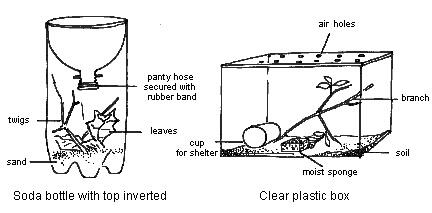
- Provide water either by very lightly misting the interior of the container or by setting out a bit of clean, damp sponge.
- Provide hiding places, like some vegetation from the area where the animal was collected, a crumpled piece of paper towel, a paper cup, or a toilet paper roll.
- Keep the container out of direct sun, or the creatures will cook.
- Use a clear container that gives the animal enough room to move about. A wide-mouthed jar, a clear 2- or 3-liter soda bottle with the top cut off and then inverted for a cover, a clear plastic shoe box, or a small aquarium are all good choices. Provide for air circulation. Either punch holes in the lid of the container or cover the top with old panty hose, cotton cloth, or cheesecloth. Secure the fabric with a rubber band.
- Plan to release your guest in a few hours, or at the most, a few days. Take it back to the same spot to let it go.
- Note: Some arthropods that make good classroom pets can be purchased inexpensively from biological supply houses. A sampling of what you can buy includes crayfish, hermit crabs, tarantulas, milkweed bugs, mealworms, butterflies, ants, and many more.
-
More About This Resource...
-
In this Biodiversity Counts activity, students learn how to replicate an arthropod's natural habitat in order to create suitable guest quarters. The online page includes:
- Instructions for what to observe in an arthropod's environment (temperature, light, moisture, etc.).
- Tips for converting a container, such as a soda bottle or aquarium, into a hospitable habitat with plenty of oxygen, water, hiding places, and other arthropod necessities.
- Notes about what to feed the arthropod and where to purchase both arthropods and their food.
- A reminder to release the arthropod guest in a few hours, if possible, but no later than a few days.
-
Completion Time
Less than 1 period
-
Topic
Biology -
Subtopic
Tools and Methods -
Subtopic
National Science Education Standards
Grades 5-8:
Science as Inquiry CONTENT STANDARD A:• abilities necessary to do scientific inquiry
Physical Science CONTENT STANDARD B:
• properties and changes of properties in matter
Life Science CONTENT STANDARD C:
• structure and function in living systems• regulation and behavior• populations and ecosystems
Science and Technology CONTENT STANDARD E:
• abilities of technological design• understandings about science and technology
History and Nature of Science CONTENT STANDARD G:
• science as a human endeavor• nature of science
Grades 9-12:
Science as Inquiry CONTENT STANDARD A:• abilities necessary to do scientific inquiry
Physical Science CONTENT STANDARD B:
• structure and properties of matter
Life Science CONTENT STANDARD C:
• behavior of organisms
Science and Technology CONTENT STANDARD E:
• abilities of technological design• understandings about science and technology
History and Nature of Science CONTENT STANDARD G:
• science as a human endeavor• nature of scientific knowledge
-
Learning Standard
National Science Education Standards
Grades 5-8:
Science as Inquiry CONTENT STANDARD A:• abilities necessary to do scientific inquiry
Physical Science CONTENT STANDARD B:
• properties and changes of properties in matter
Life Science CONTENT STANDARD C:
• structure and function in living systems• regulation and behavior• populations and ecosystems
Science and Technology CONTENT STANDARD E:
• abilities of technological design• understandings about science and technology
History and Nature of Science CONTENT STANDARD G:
• science as a human endeavor• nature of science
Grades 9-12:
Science as Inquiry CONTENT STANDARD A:• abilities necessary to do scientific inquiry
Physical Science CONTENT STANDARD B:
• structure and properties of matter
Life Science CONTENT STANDARD C:
• behavior of organisms
Science and Technology CONTENT STANDARD E:
• abilities of technological design• understandings about science and technology
History and Nature of Science CONTENT STANDARD G:
• science as a human endeavor• nature of scientific knowledge
-
