Flesh Out a Fossil
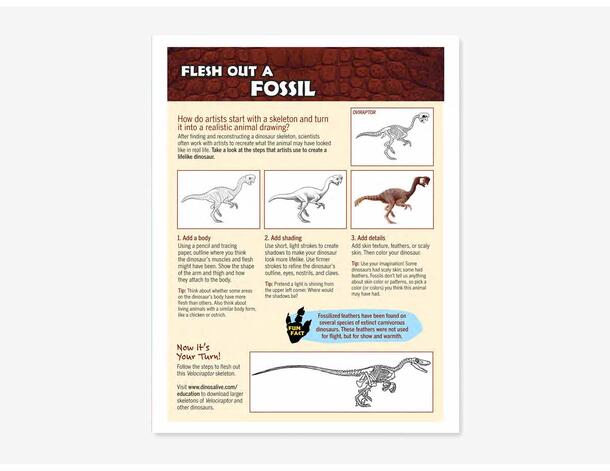
Discover how artists bring dinosaur skeletons to life with skin, feathers, and other features. Then try to create your own lifelike Velociraptor from a skeletal drawing.
-
More About This Resource...
-
This activity, available as a one-page printable handout, was designed to complement Dinosaurs Alive! — an IMAX film that follows AMNH paleontologists around the globe as they uncover some of the greatest dinosaur finds in history. This activity includes:
- A step-by-step explanation of how artists work from a reconstructed dinosaur skeleton to re-create what the animal may have looked like in real life
- An illustration of a Velociraptor skeleton that students are challenged to turn into a lifelike drawing, as wells as a link with they can find other dinosaur skeletons
- A fun fact about dinosaurs
-
Completion Time
Approximately 1 period
-
Teacher Tip
Supplement a study of paleontology with a classroom activity drawn from this Dinosaurs Alive! IMAX film activity.
- Ask students: How do artists start with a fossil skeleton and turn it into a realistic animal drawing?
- Distribute copies of the activity sheet. After reviewing the steps, have students try their hand at fleshing out the Velociraptor skeleton.
- As a class, discuss the activity and ask for volunteers to display their drawings. What students find the activity easy or hard? How did they make decisions such as skin color or patterns?
-
Topic
Paleontology -
Subtopic
Tools and Methods -
Subtopic
National Science Education Standards
Grades K-4:
Life Science CONTENT STANDARD C:• the characteristics of organisms
History and Nature of Science CONTENT STANDARD G:
• science as a human endeavor
Grades 5-8:
Life Science CONTENT STANDARD C:• diversity and adaptations of organisms
History and Nature of Science CONTENT STANDARD G:
• science as a human endeavor
Grades 9-12:
Life Science CONTENT STANDARD C:• behavior of organisms
History and Nature of Science CONTENT STANDARD G:
• science as a human endeavor
-
Learning Standard
National Science Education Standards
Grades K-4:
Life Science CONTENT STANDARD C:• the characteristics of organisms
History and Nature of Science CONTENT STANDARD G:
• science as a human endeavor
Grades 5-8:
Life Science CONTENT STANDARD C:• diversity and adaptations of organisms
History and Nature of Science CONTENT STANDARD G:
• science as a human endeavor
Grades 9-12:
Life Science CONTENT STANDARD C:• behavior of organisms
History and Nature of Science CONTENT STANDARD G:
• science as a human endeavor
-