PROFILE: Clare Flemming
Part of the Biodiversity Crisis Curriculum Collection.
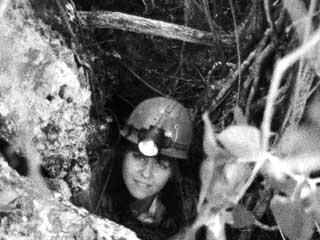
A Field Associate for the American Museum of Natural History’s Department of Mammalogy, Clare Flemming spends much of her time climbing rocks, rappelling down cliffs, and crawling through tight spaces in caves. Why? “Because that’s where the bones are, and bones are what I am looking for.” An expert on a family of large extinct rodents that lived on Caribbean Islands, Flemming has found fragments of bones and teeth that have contributed greatly to the picture of what once lived on the island of Puerto Rico. “What we know today as rodents are a small fraction of what once existed. For instance, there are no native land mammals on the island of Puerto Rico. In fact, bats are the only native mammals living on the island. But several thousand years ago, very large rodents inhabited most of the island.”
Flemming, who works with Ross MacPhee, Curator of Vertebrate Paleontology (Mammalogy) at the Museum, sees a clear connection between her research and biodiversity. “We don’t know what is extinct and how much diversity once existed until we find evidence. This evidence is found as bone fragments and teeth that remain thousands of years after the animals have disappeared. Reconstructing a whole animal or group of animals from these little pieces is like doing a giant jigsaw puzzle about life.”