Milutin Milankovitch: Seeking the Cause of the Ice Ages
Part of the Earth Inside and Out Curriculum Collection.
What causes an ice age? Will another one occur? Since it had become generally recognized by the mid-nineteenth-century that much of Europe had once been covered by a great sheet of ice, scientists have been wondering what could cause such vast shifts in the Earth’s climate. Some began looking for underlying astronomical causes. They already knew that the tilt of Earth’s axis caused seasonal change, and also that small variations in Earth’s orbit, over tens of thousands of years, affected the amount of solar energy reaching Earth. Several scientists had proposed the existence of a cycle of global winters, but none of their figures seemed accurate, and testing their reliability was difficult. Each theory was eventually shelved.
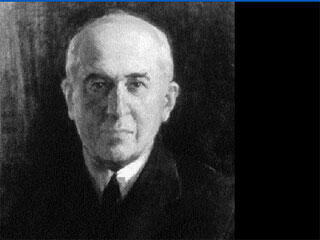
In 1911 a young Serbian mathematician, Milutin Milankovitch, decided to chart the ice ages of the Pleistocene. (The Pleistocene is the epoch that began 1.8 million years ago and ended about 11,500 years ago. It was characterized by lengthy ice ages, when glaciers covered large regions of the continents, interrupted by short interglacial periods, when the climate was temperate.) All Milankovitch’s calculations were done by hand, and he worked at them obsessively for the next thirty years. He incorporated new information about small variations in the tilt of the Earth’s axis, and factored in small orbital changes caused by the gravitational tug of other planets. Each of these orbital variations has its own time scale, and consequently they interact in different ways over time, but each one is regular. Going back 600,000 years in his computations, he carefully calculated the effect of these factors on incoming solar radiation across the Northern Hemisphere. The charts and tabulations Milankovitch created are still used today. He also measured summer solar radiation curves in high northern latitudes, where the ice age glaciers originated, linking certain low points with four previous European Pleistocene ice ages. Ultimately, the mathematician arrived at a complete astronomical theory of glaciation.
On the basis of his analysis, Milankovitch concluded that Earth’s orbit changes in three cycles of different lengths. The shape of Earth’s orbit around the Sun changes from less to more and back to less elliptical in about 96,000 years. The Earth is tilted on its axis of rotation relative to the solar plane, currently at an angle of 23.5°. This tilt changes, however, from 21.5° to 24.5° and back again in about 41,000 years. Finally, the Earth’s axis of spin wobbles with a period of 23,000 years. The challenges for Milankovitch were to understand when the three cycles were coincident with each other and how they worked together to influence insolation (the amount of solar radiation received by the Earth). Based on his computations, Milankovitch theorized variations of more than twenty percent in the amount of sunshine reaching the northern latitudes. In his 1941 account, Canon of Insolation and the Ice Age Problem, he suggested that this caused the waxing and waning of the great continental ice sheets.
Like that of several predecessors, Milankovitch’s work was greeted with considerable excitement, but was then largely dismissed. Ice ages are difficult to date, partly because each erases much of the traces of its predecessor. However, the tables were turned by the late 1960s. Technical advances made it possible for geologists to study deep-sea sediment cores that contain a climate record going back millions of years. This climate record shows remarkably regular variations, which correlate with the mathematician’s figures and which are now known as Milankovitch cycles. However, it is also clear that astronomical factors alone cannot cause the large changes that the Earth experienced. Other factors must also influence climate but scientists still do not know how.
This is an excerpt from EARTH: INSIDE AND OUT, edited by Edmond A. Mathez, a publication of the New Press. © 2000 American Museum of Natural History.
|
|
|