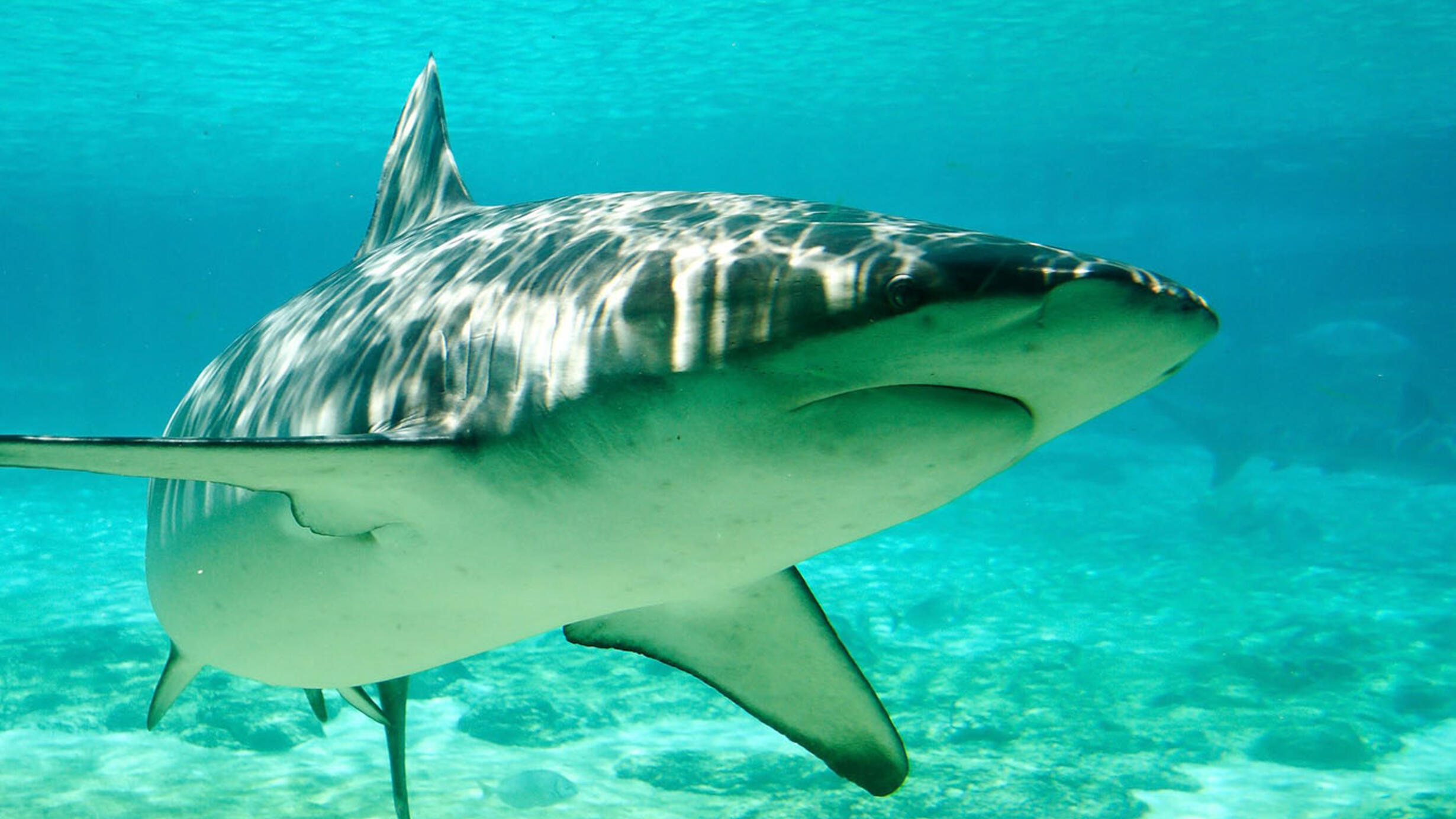
 Dusky shark (Carcharhinus obscurus).
S. Garner/Wikimedia Commons
Dusky shark (Carcharhinus obscurus).Both are elasmobranchs, a subclass of fishes with cartilaginous skeletons, and five to seven gill slits. Beyond these similarities, both classes of fish inspire a certain sense of awe - that often has more to do with myth than fact.
Here are six common myths about sharks and rays.
Some sharks must swim constantly in order to keep oxygen-rich water flowing over their gills, but others are able to pass water through their respiratory system by a pumping motion of their pharynx. This allows them to rest on the sea floor and still breathe. However, sharks do have to swim to avoid sinking to the bottom of the water column. The ability to move up and down freely in the water column is, in fact, one of the extraordinary adaptations of sharks.
Unlike bony fishes, which tend to be restricted to certain depth ranges, sharks are able to move easily between varying depths in the water. Bony fishes utilize swim bladders to move up or down vertically in the water or remain at a uniform depth. The swim bladder works by varying the amount of gas it contains, giving the fish buoyancy. Sharks, on the other hand, do not have a swim bladder. Instead, they rely on lift generated by their large pectoral fins, much like the way an airplane's wings provide lift in the air. In addition to the lift by the fins, sharks also have very large livers that contain a high proportion of oil. This oil is lighter than water, providing the shark with additional buoyancy.
The lack of a swim bladder gives sharks some unique advantages. One benefit of not having this organ is that the shark's body is incompressible, allowing it to move between different depths without the risk of exploding or imploding. Bony fishes with swim bladders, on the other hand, risk their lives if they go too shallow or too deep in the water, because the air contained in a swim bladder compresses or decompresses depending on pressure changes. A bony fish living at great depths and pressures would die if it came too far up in the water column, because of the pressure differential. Since sharks don't have the air bladder, they can come from great depths up to the surface and survive.
Sharks are generally perceived as vicious predators. Well known movies such as Jaws have popularized this perception, making sharks some of the most feared creatures in the animal kingdom. However, this perception is based largely on myth. The reality is that only a handful of the more than 350 species of shark in the world's oceans are considered dangerous to humans. In fact, more people are killed each year by deer, dogs, and domestic pigs than by sharks. And, get this: in the United States, the annual risk of dying from a lightning strike is 30 times greater than that of dying from a shark attack!
Although most sharks are predators, the two largest species (the basking shark and whale shark) have no obvious teeth and eat only plankton. The majority of sharks eat fish and invertebrates, while some feed upon marine mammals such as seals and sea lions. Remains of other animals have been found in shark stomachs as well, including crustaceans, cows, reindeer, chickens, dogs, penguins and other birds, not to mention a number of more intriguing items, like tin cans, a wristwatch, an engine block, a partial suit of armor, parts of a rocking chair, bottles, buttons, shoes, belts, and a handbag.
Conspicuously absent from the list of a shark's preferred dietary choices are human beings. As a matter of fact, over 75% of all shark species rarely encounter human beings and/or they are incapable of consuming a human being. Of the shark attacks that do occur, most are in the waters off the coasts of South Africa and Australia. According to the Reader's Digest book Sharks, it is estimated that in the United States, for every 1,000 people who drown, there is one shark attack. In South Africa, for every 600 drownings there is one shark attack, and in Australia, for every 50 drownings there is one shark attack. Nearly all shark attacks are the result of feeding stimulation (chumming) by fishermen, mistaken identity (e.g., from a shark's point of view, a person paddling on a surfboard may resemble a sea lion), or justified self-defense against aggressive humans.
So, the next time you're afraid to swim for fear of a shark attack, remember this: you are more justified in fearing a pig attack while slopping the hogs!
Many people think that there is only one kind of ray–the stingray. While it is true that rays and skates are perhaps not as popular with the media as their close cousins the sharks, they in fact exhibit an even greater diversity. Over 600 species are represented in a range of habitats–from the cold northern waters of the Pacific and Atlantic Oceans to the frigid Antarctic; in cool, temperate, warm, and tropical seas; and coastal and pelagic waters. Some species of rays permanently inhabit freshwaters, while sharks are primarily marine. Some species of sharks enter freshwater, but with few questionable exceptions, none is known to spend its entire life in fresh water.
Rays differ from sharks primarily in being "flattened," which has engendered a number of adaptations–their pectoral fins are enlarged and fused to their bodies and their mouth, nostrils and gills are located on their undersides, while their eyes are found on their dorsal surfaces. The demarcation between sharks and rays is not so clear–they are members of the same class, and there are a number of species which are classified as one, but superficially resemble the other. The angel shark, for example, is a shark, but has a ray-like body and is more closely related to rays than it is to other sharks. The sawfish is classified as a ray, but with the exception of its elongated saw-like snout (which is quite unique in the animal kingdom), looks much more like a shark. There are about 185 species of stingrays, approximately 35 of which live exclusively in fresh water.
Out of the 600 species of rays, only one group - the stingrays - possess caudal stings. Many other rays have long, stout, strong tails endowed with dorsal fins, and swim like sharks (i.e., by moving their tails from side to side, and not by undulating movements of their discs, as is more typically associated with rays). Stingrays use their stings strictly for defense. When triggered by pressure on the back of the stingray, the tail is suddenly and powerfully thrusted upward and forward, into the victim, which makes the stingray dangerous only if stepped on. Native South Americans who live by rivers where freshwater stingrays are present will advise newcomers to drag their feet when venturing into the water. That way, stingrays are harmlessly kicked out of the way and not stepped on.
When you think of a shark, do you think of the great white–enormous, man-eating, dorsal-finned predator of the open sea? While it is true that the approximately 400 described species of sharks have a number of common traits, they in fact exhibit a remarkable diversity.
While many shark species inhabit relatively shallow coastal waters, a number of shark species do occur in the open ocean at depths greater than 1,000 meters–these include kitefin sharks (Dalatias licha), lantern sharks (Etmopterus hillianus), catsharks (family Scyliorhinidae), and the Portuguese shark (Centroscymnus coelolepis), which has been found at depths of 3,690 meters. Sharks live in tropical and temperate seas, and also inhabit the frigid Arctic regions. Some sharks are even diadromous–that is, they migrate between salt and freshwater habitats.
No shark species subsists solely on vegetable matter, but not all sharks exhibit predatory behavior to obtain food. Some sharks, including the two largest species—the whale shark (Rhincodon typus) and the basking shark (Cetorhinus maximus)—are filter feeders that eat only plankton. Dentition varies with food type–sharks that feed on mollusks and crustaceans use their flat molar-like teeth for crushing; mako (genus Isurus) and tiger sharks (Galeocerdo cuvier) have long, thin teeth used for piercing and grasping fish and squid; and most requiem sharks (family Carcharhinidae) have serrated teeth that cut their prey.
Sharks range in size from the small 16 cm, 15 g dwarf dogshark (Etmopterus perryi) to the gigantic 12 m, 12,000 kg whale shark (the largest fish in the world). The angel shark's (Squatina dumeril) body is flattened, allowing it to camouflage itself on the ocean floor, and in this way is convergent with rays. Even the fusiform shape of most sharks varies in proportions. And let's not overlook the strange cranial morphology of the great hammerhead (Sphyrna mokarran). Although sharks do not exhibit the fantastic range of coloration seen in bony fishes, there are many that do vary in color and markings, and some change throughout their life cycles. The zebra shark, for example, is born with strong white stripes over a dark brown background, but as the creature grows, stripes change to brownish spots over a palish, dusky green background. The smalleye hammerhead (Sphyrna tudes) is born orange, changing to yellow as it ages.
Sharks are often portrayed as having an almost supernatural sense of smell. However, reports that sharks can smell a single drop of blood in a vast ocean are greatly exaggerated. While some sharks can detect blood at one part per million, that hardly qualifies as the entire ocean. Sharks do, however, have an acute sense of smell and a sensitive olfactory system–much more so than humans. Sharks' nostrils are located on the underside of the snout, and unlike human nostrils, are used solely for smelling and not for breathing. They are lined with specialized cells that comprise the olfactory epithelium. Water flows into the nostrils and dissolved chemicals come into contact with tissue, exciting receptors in the cells. These signals are then transmitted to the brain and are interpreted as smells.
Because of the extreme sensitivity of these cells, as well as the fact that the olfactory bulb of the brain is enlarged, sharks can detect miniscule amounts of certain chemicals. This varies, of course, among different species of sharks and the chemical in question. The lemon shark can detect tuna oil at one part per 25 million–that's equivalent to about 10 drops in an average-sized home swimming pool. Other types of sharks can detect their prey at one part per 10 billion; that's one drop in an Olympic-sized swimming pool! Some sharks can detect these low concentrations of chemicals at prodigious distances–up to several hundred meters (the length of several football fields)—depending on a number of factors, particularly the speed and direction of the water current.
Predation is not the only behavior in which olfaction plays a crucial role. Evidence exists that this keen sense of smell is also instrumental in sexual behavior. Males are able to detect pheromones produced by females, even in low concentrations, helping them locate potential mates.
The idea that sharks don't get cancer seems to stem from scant clinical evidence that cartilage has antiangiogenic properties–i.e., it inhibits the development of blood vessels, which are crucial to the growth of cancerous tumors–and since shark skeletons are made of cartilage, it follows (albeit somewhat loosely) that they can't get cancer. Recent studies and literature reviews have found that while the incidence of cancer in sharks and related fishes such as rays does seem to be low, cancerous tumors, including chondromas (cancers of the cartilage), have in fact been found in sharks. The reasons for the apparently low incidence are not necessarily related to their high cartilage content, but may simply be a matter of lack of directed research on cancer in sharks and related fishes.
While cartilage may have antiangiogenic properties, orally ingesting powdered shark cartilage has not been shown to be an effective cancer treatment or prevention, because none of the constituent parts of the powder appear to be absorbed across the intestine wall into the bloodstream.
Besides the lack of evidence that shark cartilage prevents or cures cancer in humans, the fishing of sharks for manufacturing shark cartilage products endangers shark populations and upsets fragile marine ecosystems. The myth that "sharks don't get cancer" is thus both a medical fallacy and results in the pointless slaughter of sharks, jeopardizing the existence of the species.
Sharks can gestate for up to two years. The Indian elephant has a gestation period of 22 months; humans, nine months; and mice, a mere three weeks.
Sharks and rays don't have bones. Their skeletons are composed entirely of cartilage, like human noses.
Sharks have been around since well before the Age of Dinosaurs. Their evolutionary record extends back 450 million years.
Sharks and rays are cosmopolitan in distribution. They are found in waters all over the planet, from shallow coastal waters to the dark depths of the open ocean, from tropical seas to the Arctic and Antarctic regions, and even in salt water and fresh water.
Individual shark can produce upwards of thirty thousand teeth in its lifetime. When a tooth wears down, it falls out and is replaced by one from the rows behind it.
Shark skin, or shagreen, feels rough if you stroke it in one direction (back to front), but smooth if you stroke it in the other (front to back). Shark skin is covered with modified scales, known as dermal denticles, which contribute to their superb hydrodynamics. Fabric for high-tech racing swimsuits, seen in recent Olympic competition, has been modeled after it as this design reduces drag and turbulence.