Celebrating Hauntingly Photogenic Natural History And Research from the Division of Invertebrate Zoology
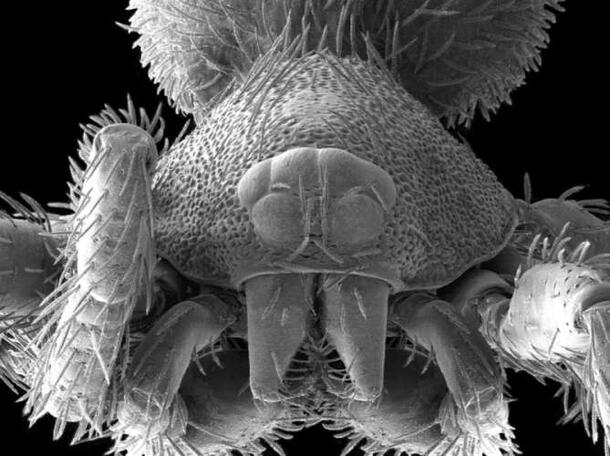
Dracula orchids tempt flies by masquerading as mushrooms. Goblin spiders lurk unseen in the world’s leaf litter. The natural world is often just as haunting as the macabre costumes worn on city streets, as highlighted by two studies published this year by curators in the Division of Invertebrate Zoology at the American Museum of Natural History, David Grimaldi and Norman Platnick.
Dracula Orchids
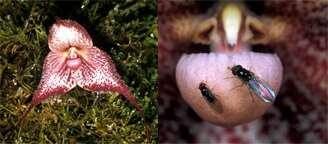
According to Grimaldi and colleagues, fruit flies (Drosophilidae) of the genus Zygothrica typically swarm on mushrooms and other rain forest fungi. But one group of orchids in the American tropics takes advantage of their preferences, duping the hapless flies into pollinating them with the scent and appearance of mushrooms. These orchids are from the genus Dracula, named so to keep the spirit of a former name, Masdevallia, when it was realized that there were separate orchid groups.
“Over 200 years ago, botanists on major Spanish expeditions to Peru named a new orchid Masdevallia because of the flower’s similarity to monsterly creatures like dragons and bats,” says Lorena Endara of the University of Florida in Gainesville. “Carlyle Luer, who later segregated Dracula from Masdevallia, sees these orchids as little bats flying in the forest since the flower faces down and the triangular sepals and the long sepaline tails display parallel to the ground."
“Some of the flies attracted to Dracula are new species, and I am presently working on descriptions of them,” says Grimaldi. “I wanted to call this paper ‘Dracula as Lord of the Flies,’ but my co-authors convinced me to use the title ‘Lord of the Flies: Pollination of Dracula orchids.’”
The paper, published in the orchid journal Lankesteriana, presents over 700 hours of observational data on flowers in Ecuadorian cloud forest where fruit flies were seen mating in (and hence pollinating) Dracula orchids. In addition to Endara and Grimaldi, Bitty Roy of the University of Oregon authored the paper; the research was funded by the National Science Foundation, the National Geographic Society, and other institutions.
Goblin Spiders
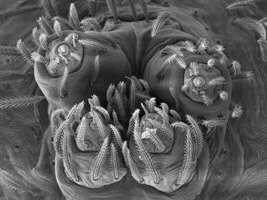
Over the past three years, Platnick and colleagues have named or redefined the taxonomy of hundreds of new species of goblin spiders—an often overlooked group named for their unusual appearance and secretive habits. Goblin spiders (members of the family Oonopidae) are extremely small: the largest is 3 millimeters in size, and most are under 2 millimeters.
“Goblins are probably the most poorly known group of spiders,” says Platnick. “Their small size has made them difficult to study, but scanning electron microscopy and recent advances in digital imaging are allowing us to examine their structures in much more detail than was previously possible.”
A recently published Bulletin of the American Museum of Natural History unravels the previous taxonomy of the genus Stenoonops, a group of spineless goblin spiders that have a soft abdomen and muddy-orange carapace. Fourteen of the 19 species moved to new genera (in fact, six different genera). But because 17 new species from the Caribbean were described as Stenoonops, the genus increased in numbers and now has 23 species. Two other genera are given new species as well: Longoonops and Australoonops gain five species combined.
“It isn’t surprising that there are so many undescribed goblin spiders,” says Platnick. “When we began the global inventory of the Oonopidae, there were only about 500 species known, a number we thought represented about 20 percent of the actual biodiversity in this group. There are a lot of species that have small ranges—the perfect group for giving us hints about the biogeographic histories of the areas they occupy, as well as for conservation, by showing us what areas are most in need of protection against habitat destruction.”
Media Inquiries: Department of Communications, 212-769-5800