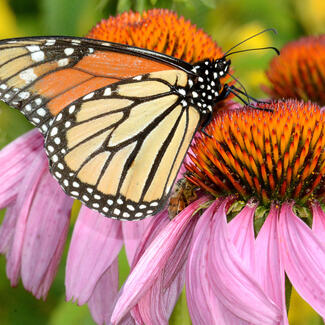
Asclepias spp.

Asclepias tuberosa, Orange Milkweed, Butterfly Weed: perennial.
Native to North America. Other recommended species include A. syriaca (Common Milkweed) and A. incarnata (Swamp Milkweed).
Asclepias spp. Milkweed.
Host plant of the Monarch butterfly, this is a great nectar source as well.

Close Window
"); win.document.close(); } if(pagename =="aster"){ var win = window.open("", "win", "width=250,height=425"); win.document.open("text/html", "replace"); Aster spp.win.document.write("Aster spp.
Aster spp.

Aster spp. Aster: perennial.
Recommended species include: A. novae-angliae (New England Aster), A. novi-belgii (New York Aster), and A. x frikartii (Frikart Aster).
Aster spp. Aster.
Host plants of the Pearl Crescent; also an important nectar source.

Close Window
"); win.document.close(); } if(pagename =="buddleia"){ var win = window.open("", "win", "width=250,height=400"); win.document.open("text/html", "replace"); Buddleia davidiiwin.document.write("Buddleia davidii
Buddleia davidii

Buddleia davidii, Butterfly Bush: shrub.
Native to china.

Close Window
"); win.document.close(); } if(pagename =="cephalanthus"){ var win = window.open("", "win", "width=250,height=400"); win.document.open("text/html", "replace"); Cephalanthus occidentaliswin.document.write("Cephalanthus occidentalis

Cephalanthus occidentalis, Button-bush: large shrub.
Native to North America.

Close Window
"); win.document.close(); } if(pagename =="clerthra"){ var win = window.open("", "win", "width=250,height=400"); win.document.open("text/html", "replace"); Clerthra alnifoliawin.document.write("Clerthra alnifolia

Clerthra alnifolia, Sweet Pepperbush: shrub.
Native to North America.

Close Window
"); win.document.close(); } if(pagename =="echinacea"){ var win = window.open("", "win", "width=250,height=400"); win.document.open("text/html", "replace"); Echinacea purpureawin.document.write("Echinacea purpurea
Echinacea purpurea

Echinacea purpurea, Purple Coneflower: perennial.
Native to North America.

Close Window
"); win.document.close(); } if(pagename =="eupatorium"){ var win = window.open("", "win", "width=250,height=400"); win.document.open("text/html", "replace"); Eupatorium spp.win.document.write("Eupatorium spp.
Eupatorium spp.

Eupatorium spp. Joe-Pye Weed: perennial.
Native to North America. Recommended species include: E. purpureum, E. fistulosum, and E. maculatum.

Close Window
"); win.document.close(); } if(pagename =="liatris"){ var win = window.open("", "win", "width=250,height=400"); win.document.open("text/html", "replace"); Liatris spicatawin.document.write("Liatris spicata

Liatris spicata, Gayfeather: perennial.
Native to United States. Related species include L. pycnostachya, L. punctata, and L. scariosa.

Close Window
"); win.document.close(); } if(pagename =="monarda"){ var win = window.open("", "win", "width=250,height=400"); win.document.open("text/html", "replace"); Monarda didymawin.document.write("Monarda didyma

Monarda didyma, Bee Balm: perennial.
Native to North America.

Close Window
"); win.document.close(); } if(pagename =="phlox"){ var win = window.open("", "win", "width=250,height=400"); win.document.open("text/html", "replace"); Phlox paniculatawin.document.write("Phlox paniculata
Phlox paniculata

Phlox paniculata, Garden Phlox, Summer Phlox: perennial.
Native to the United States. Related species include P. maculata and P. divaricata.

Close Window
"); win.document.close(); } if(pagename =="pycnanthemum"){ var win = window.open("", "win", "width=250,height=400"); win.document.open("text/html", "replace"); Pycnanthemum muticumwin.document.write("Pycnanthemum muticum
Pycnanthemum muticum

Pycnanthemum muticum, Mountain Mint: perennial.
Native to North America.

Close Window
"); win.document.close(); } if(pagename =="rhododendron"){ var win = window.open("", "win", "width=250,height=400"); win.document.open("text/html", "replace"); Rhododendron spp.win.document.write("Rhododendron spp.
Rhododendron spp.

Rhododendron spp. Various shrubs.

Close Window
"); win.document.close(); } if(pagename =="rudbeckia"){ var win = window.open("", "win", "width=250,height=400"); win.document.open("text/html", "replace"); Rudbeckia hirtawin.document.write("Rudbeckia hirta
Rudbeckia hirta

Rudbeckia hirta, Black-Eyed Susan: biennial.
Native to North America. Related species include R. fulgida.

Close Window
"); win.document.close(); } if(pagename =="salvia"){ var win = window.open("", "win", "width=250,height=400"); win.document.open("text/html", "replace"); Salvia coccineawin.document.write("Salvia coccinea

Salvia coccinea, Scarlet Sage, Red Salvia: perennial.
Native to the United States. Related species include S. leucophylla (Purple Sage).

Close Window
"); win.document.close(); } if(pagename =="solidago"){ var win = window.open("", "win", "width=250,height=400"); win.document.open("text/html", "replace"); Solidago spp.win.document.write("Solidago spp.
Solidago spp.

Solidago spp. Goldenrods: perennial.
Native to North America.

Close Window
"); win.document.close(); } if(pagename =="tagetes"){ var win = window.open("", "win", "width=250,height=400"); win.document.open("text/html", "replace"); Tagetes patulawin.document.write("Tagetes patula
Tagetes patula

Tagetes patula, French Marigold: annual.
Native to Mexico.

Close Window
"); win.document.close(); } if(pagename =="verbena"){ var win = window.open("", "win", "width=250,height=400"); win.document.open("text/html", "replace"); Verbena spp.win.document.write("Verbena spp.
Verbena spp.

Verbena spp. Verbena: perennial.
Several species available.

Close Window
"); win.document.close(); } if(pagename =="vernonia"){ var win = window.open("", "win", "width=250,height=400"); win.document.open("text/html", "replace"); Vernonia noveboracensiswin.document.write("Vernonia noveboracensis
Vernonia noveboracensis

Vernonia noveboracensis, Ironweed: perennial.
Native to the United States.

Close Window
"); win.document.close(); } if(pagename =="zinnia"){ var win = window.open("", "win", "width=250,height=400"); win.document.open("text/html", "replace"); Zinnia eleganswin.document.write("Zinnia elegans
Zinnia elegans

Zinnia elegans, Common Zinnia: annual.
Native to Mexico. Many additional species available.

Close Window
"); win.document.close(); } if(pagename =="antirrhinum"){ var win = window.open("", "win", "width=250,height=400"); win.document.open("text/html", "replace"); Antirrhinum majorwin.document.write("Antirrhinum major

Antirrhinum major, Snapdragon.
Host plant of the Common Buckeye.

Close Window
"); win.document.close(); } if(pagename =="brassica"){ var win = window.open("", "win", "width=250,height=400"); win.document.open("text/html", "replace"); Brassica spp.win.document.write("Brassica spp.

Brassica spp. Mustard.
Host plant for several species of the family Pieridae.

Close Window
"); win.document.close(); } if(pagename =="chelone"){ var win = window.open("", "win", "width=250,height=400"); win.document.open("text/html", "replace"); Chelone glabrawin.document.write("Chelone glabra

Chelone glabra, Turtlehead.
Host plant of the Baltimore Checkerspot.

Close Window
"); win.document.close(); } if(pagename =="cirsium"){ var win = window.open("", "win", "width=250,height=400"); win.document.open("text/html", "replace"); Cirsium spp.win.document.write("Cirsium spp.

Cirsium spp. Thistles.
Host plant for the Painted Lady; also an excellent nectar source. Exercise caution when planting thistles, as they can be very invasive plants. Planting thistles in separate tubs will contain their root systems, and removing flowers after the blooms have wilted will help to prevent the spreading of seeds.

Close Window
"); win.document.close(); } if(pagename =="foeniculum"){ var win = window.open("", "win", "width=250,height=400"); win.document.open("text/html", "replace"); Foeniculum vulgarewin.document.write("Foeniculum vulgare
Foeniculum vulgare

Foeniculum vulgare, Fennel.
This is one of the host plants of the Eastern Black Swallowtail. Other host plants of this swallowtail include parsley (Petroselinum spp.), carrot, and dill.

Close Window
"); win.document.close(); } if(pagename =="gnaphalium"){ var win = window.open("", "win", "width=250,height=400"); win.document.open("text/html", "replace"); Gnaphalium obtusifoliumwin.document.write("Gnaphalium obtusifolium

Gnaphalium obtusifolium; Catfoot, Pussy-Toes.
Host plant for the American Lady.

Close Window
"); win.document.close(); } if(pagename =="medicago"){ var win = window.open("", "win", "width=250,height=400"); win.document.open("text/html", "replace"); Medicago sativawin.document.write("Medicago sativa

Medicago sativa, Alfalfa.
Host plant of the Orange Sulphur; also an important nectar source.

Close Window
"); win.document.close(); } if(pagename =="prunus"){ var win = window.open("", "win", "width=250,height=455"); win.document.open("text/html", "replace"); Prunus serotinawin.document.write("Prunus serotina
Prunus serotina

Prunus serotina, Wild Black Cherry.
Room for trees? This species is a host plant of the Red-Spotted Purple and the Eastern Tiger Swallowtail. Another host of the Eastern Tiger Swallowtail is the Tulip Tree (Liriodendron tulipifera). Coral Hairstreak caterpillars also feed on Prunus spp., including cherry and plum.

Close Window
"); win.document.close(); } if(pagename =="salix"){ var win = window.open("", "win", "width=250,height=400"); win.document.open("text/html", "replace"); Salix spp.win.document.write("Salix spp.
Salix spp.

Salix spp. Willow.
More room for trees? Willows are the host plants of Mourning Cloaks and Viceroys.

Close Window
"); win.document.close(); } if(pagename =="sassafras"){ var win = window.open("", "win", "width=250,height=400"); win.document.open("text/html", "replace"); Sassafras albidumwin.document.write("Sassafras albidum

Sassafras albidum, Sassafras.
Host plant of the Spicebush Swallowtail. As the common name implies, another host plant of this butterfly is Spicebush, Lindera benzoin.

Close Window
"); win.document.close(); } if(pagename =="urtica"){ var win = window.open("", "win", "width=250,height=400"); win.document.open("text/html", "replace"); Urtica dioicawin.document.write("Urtica dioica

Urtica dioica, Stinging Nettle.
As the common name implies, this plant will sting you, so think twice before planting it. It is the host plant for Red Admirals, Commas, and Milbert's Tortoiseshell. Exercise caution when planting nettles, as they can be invasive. Planting nettles in separate tubs will contain their root system, and removing flowers after the blooms have wilted will help to prevent spreading of seeds.

Close Window
"); win.document.close(); } if(pagename =="viola"){ var win = window.open("", "win", "width=250,height=400"); win.document.open("text/html", "replace"); Viola spp.win.document.write("Viola spp.
Viola spp.

Viola spp. Violets: host plants for the Variegated Fritillary, the Great-Spangled Fritillary, and other fritillaries.

Close Window
"); win.document.close(); } } // -->
  • Facebook
  • Flickr
  • Foursquare
  • RSS
  • Twitter
  • YouTube
Exhibition Highlights Exhibition
Highlights
Butterfly Cams Butterfly
Cams
Ticket Info Ticket
Info
FAQ FAQ
Grow A Butterfly Garden
Downloadable Backgrounds Downloadable Backgrounds
Monarch Butterflies

A butterfly garden, large or small, can attract butterflies to your back yard. Here are some tips for creating your own garden:

  • Sunny gardens attract the most butterflies, so plant in the brightest part of your garden.
  • Some important details to consider are sunny spots for basking, shelter from wind and rain and sources of fresh water. Mud or sand puddles are used by adult male butterflies to obtain essential salts, needed for reproduction.
  • Nectar plants provide food for a variety of adult butterflies, while different host plants, which supply caterpillars with food, attract specific species. Keep in mind that nectar plants may also serve as host plants to some species. You may want to include both in your garden.
  • Most caterpillars feed only on specific types of host plants, so female adult butterflies deposit their eggs only on those plants their offspring will eat. By including host plants in your garden, you could witness the entire life cycle of the butterfly.
  • Choose plants that will bloom at different times throughout the season. Try experimenting with a variety of plants that appeal to different butterfly species.
  • Pesticides can harm butterflies, so avoid using them whenever possible.
  • Do some research before you begin planting to determine which plants to use and how much space is required. Butterfly gardening books and websites can help you make decisions. Also, ask your local native plant society if there are restrictions on particular plant species in your area.

Nectar Plants

Here are some Northeastern nectar plants to consider for your butterfly garden. Some are common garden flowers, while others are wildflowers that may be more difficult to find:

Asclepias tuberosa
Aster spp.
Buddleia davidii
Cephalanthus occidentalis
Clerthra anlifolia
Echinacea purpurea
Eupatorium spp.
Liatris spicata
Monarda didyma
Phlox paniculata
Pycnanthemum muticum
Rhododendron spp.
Rudbeckia hirta
Salvia coccinea
Solidago spp.
Tagetes patula
Verbena spp.
Vernonia noveboracensis
Zinnia elegans

Some of the butterflies that utilize these plants for nectar include:

Family Papilionidae
Black Swallowtail (Papilio polyxenes)
Eastern Tiger Swallowtail (Papilio glaucus)

Family Pieridae
Cabbage White (Pieris rapae)
Orange Sulphur (Colias eurytheme)
Clouded Sulphur (Colias philodice)

Family Lycaenidae
American Copper (Lycaena phlaeas)
Gray Hairstreak (Strymon melinus)
Spring Azure (Celastrina ladon)
Eastern Tailed Blue (Everes comyntas)

Family Nymphalidae
Great Spangled Fritillary (Speyeria cybele)
Pearl Crescent (Phyciodes tharos)
American Lady (Vanessa virginiensis)
Painted Lady (Vanessa cardui)
Baltimore Checkerspot (Euphydryas phaeton)
Common Buckeye (Junonia coenia)
Monarch (Danaus plexippus)

Family Hesperiidae
Silver-spotted Skipper (Epargyreus clarus)
Fiery Skipper (Hylephila phyleus)
European Skipper (Thymelicus lineola)


Host Plants

Consider experimenting with some butterfly host plants as well. Here are some possibilities for your Northeast butterfly garden:

Antirrhinum major
Asclepias spp.
Aster spp.
Brassica spp.
Chelone glabra
Cirsium spp.
Foeniculum vulgare
Gnaphalium obtusifolium
Medicago sativa
Prunus serotina
Salix spp.
Sassafras albidum
Urtica dioica
Viola spp.

Resources

Books

Grow a Butterfly Garden by Liz Primeau, et al. Hardcover (March 2000)

The Butterfly Garden by Judith Levicoff. Paperback (October 1994)

Creating a Butterfly Garden : A Guide to Attracting and Identifying Butterfly Visitors by Marcus H. Schneck. Paperback (May 1994)

Grow a Butterfly Garden by Wendy Potter Springer. Paperback (September 1990)

The Butterfly Garden: Turning Your Garden, Window Box, or Backyard into a Beautiful Home for Butterflies by Mathew Tekulsky, Robert M. Pyle (Designer). Paperback (January 1986)

The Butterfly Garden by Mathew Tekulsky, Robert M. Pyle (Designer). Hardcover (December 1985)

Links

North American Butterfly Association

Butterfly Website

New York Botanical Garden: Butterfly Gardens Fact Sheet

Metro NY Home & Garden

Milkweed Cafe