Monday–Friday:
Every half hour, 10:30 a.m.–4:30 p.m. except Wednesdays (first show on Wednesday begins at 11:00 a.m.)
Saturday–Sunday:
Every half hour, 10:30 a.m.–5:00 p.m.
SOUNDTRACK
about the show | synopsis | about the narrator | news | upgraded projector
A spectacular new Space Show, Journey to the Stars, narrated by Academy Award-winning actress Whoopi Goldberg, premiered on Saturday, July 4, 2009, in the Hayden Planetarium at the Frederick Phineas and Sandra Priest Rose Center for Earth and Space.
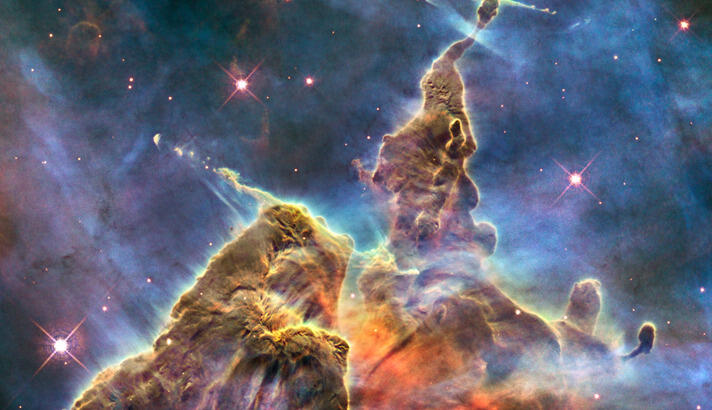
Featuring extraordinary images from telescopes on the ground and in space and stunning, never-before-seen visualizations of physics-based simulations, the dazzling new Journey to the Stars launches visitors through space and time to experience the life and death of the stars in our night sky, including our own nurturing Sun. Tour familiar stellar formations, explore new celestial mysteries, and discover the fascinating, unfolding story that connects us all to the stars. Those who come along for the journey may never see the night sky in the same way again.
Journey to the Stars is an engrossing, immersive theater experience created by the Museum’s astrophysicists, scientific visualization, and media production experts with the cooperation of the National Aeronautics and Space Administration (NASA) and more than 40 leading scientists from the United States and abroad.
more about...the curators | the script | the score | the director | the production team |
science collaborators | science and education advisors
Mordecai-Mark Mac Low, Curator, Chair of the Department of Astrophysics, Division of Physical Sciences
Dr. Mac Low’s work focuses on understanding the formation of planets, stars, and galaxies. Working with students and colleagues, he has developed numerical models at different physical scales to attack these problems. In addition to his Museum position, he also is a professor in the Department of Astronomy at Columbia University. Prior to joining the Museum staff in 1999, Dr. Mac Low was a scientist at the Max Planck Institute of Astronomy in Heidelberg, Germany. He held postdoctoral positions at the University of Chicago and at NASA Ames Research Center in California. Dr. Mac Low, who earned his Ph.D. in physics in 1989 from the University of Colorado at Boulder, is a native New Yorker who attended public schools in the Bronx and Manhattan, including Stuyvesant High School.
Ben R. Oppenheimer, Associate Curator, Department of Astrophysics, Division of Physical Sciences
Dr. Oppenheimer is primarily interested in comparative exoplanetary science, the study of planets orbiting stars other than the Sun. This nascent field is so young that we are just beginning to image and study exoplanets in detail. His laboratory in the Rose Center is the birthplace of a number of new astronomical instruments designed to tackle the problem of exoplanet imaging and spectroscopy. In March 2003, his team successfully deployed the world's most sensitive coronagraph at the AEOS Telescope in Maui, which he used to image some of the complex structures of material beginning to form planets around some nearby stars. In 2008 he moved this project to the Palomar Observatory in Southern California. There, with far greater sensitivity and capability, the instrument is engaged in a five year survey of the closest 300 stars to unravel the atmospheric chemistry of young exoplanets. Dr. Oppenheimer is also building part of a new planet imaging instrument for the International Gemini Observatory, one of the world’s largest telescopes. Dr. Oppenheimer, who serves on the current decadal survey of astronomy for the National Academies of Science, also works on faint white dwarfs, the remnants of normal stars, and brown dwarfs, objects like stars that never contained sustained fusion reactions. Dr. Oppenheimer received a B.A. in physics from Columbia University and a Ph.D. in astronomy from Caltech. He joined the Museum in 2001 and was appointed to the curatorial faculty in 2004.
Louise A. Gikow
Journey to the Stars was written by Louise A. Gikow, an Emmy award-winning author/composer of over 150 scripts, books, and songs for kids and adults. She has worked at National Lampoon magazine, The Jim Henson Company, and Nickelodeon, where she started a successful publishing and multimedia business. She was a consulting producer and staff writer for the PBS series Between the Lions, is the co-creator and head writer of the hit Playhouse Disney show Johnny and the Sprites, and is the co-creator of Lomax: The Hound of Music, a new music education show for children being developed for PBS. Louise also co-wrote the previous Space Show at the Rose Center for Earth and Space, Cosmic Collisions.
Robert Miller
Robert Miller is a prolific composer of film, concert, and commercial music. His distinctive style has made its mark on over 1400 commercials, a growing body of film scores, and works for concert and the stage. Over the years, his talent and passion have garnered him five CLIO awards. His film work includes the Lionsgate/Weinstein company release Teeth; the 2005 Sundance Grand Jury Prize winner, Why We Fight; and the 2005 Tribeca Film Festival Best Feature winner, Red Doors. His current projects include Happy Tears, Teeth-director Mitchell Lichtenstein's next feature film, and the upcoming documentary Lost Sons of Havana, produced by the Farrelly Brothers and directed by Jon Hock.
Miller was formally trained at the Mannes College of Music in New York City and studied privately with American Masters William Schuman, Aaron Copland, and Edgar Grana. He was the composer-in-residence with the New York-based Jupiter Symphony from 1996-1999.
Carter Emmart
Carter Emmart, Director of Astrovisualization at AMNH, has been involved in all of the Museum’s space shows since joining AMNH in the late 1990s. He was one of the original team members at AMNH of the NASA funded Digital Galaxy Project that helped redefine how a planetarium theater can present science to the public through immersive data visualization. Carter directs the in-house space show production at AMNH and has collaborated with the visualization teams of the National Center for Supercomputing Applications and the San Diego Supercomputer Center. AMNH full dome space shows are now playing in world wide distribution. Emmart, who previously worked at NASA Ames Research Center and the National Center for Atmospheric Research, got his BA in geophysics from the University of Colorado where he was an organizer of the Case for Mars Conference series. In May, 2006, Carter received an honorary PhD from Linkopping University in Sweden in part for his advising of a graduate intern program hosted at AMNH.
The production team for Journey to the Stars includes science visualizers, digital artists, producers, engineers, sound designers, educators and more. The Space Show’s Executive Producer is Rosamond Kinzler, an Earth scientist who received her bachelor’s, master’s and doctorate degrees from the Massachusetts Institute of Technology. Dr. Kinzler held research positions at Columbia’s Lamont Doherty Earth Observatory and in the Museum’s Earth and Planetary Sciences Department prior to co-curating the Museum's world-renowned Gottesman Hall of Planet Earth that opened in 1999. Dr. Kinzler assumed leadership of the Museum’s National Center for Science Literacy, Education and Technology in 2001, and since then she has led major award winning digital projects—on the web, in HD-media, and in print—that engage audiences that range from children, families, and the general public at home to science educators seeking graduate accredited courses online to visitors at informal learning centers across the country.
The production team of 13 members, which included lead technical directors, technical directors, camera animators, digital artists, project scientists, an associate producer and a production manager was headed by Producer Sarah Dowland. Ms. Dowland is a highly skilled Senior Visual Effects Producer. Born in Australia, she has worked with some of the most talented directors in the world on films such as The Matrix Reloaded, Harry Potter and the Prisoner of Azkaban (nominated for an Academy Award for Visual Effects), Harry Potter and the Goblet of Fire, V for Vendetta, Charlotte Gray, In The Cut, Farscape (TV) for The Jim Henson Company, South Pacific (TV), and countless TV commercials. She is currently working on Salt which was filmed in New York and DC and stars Angelina Jolie.
The highly technical production process for Hayden Planetarium space shows relies heavily on the expertise and support of the Director of Rose Center Engineering Benjy Bernhardt and his team of system architects, video and sound engineers, systems administrators and audio visual professionals.
Sunrise and Sunset Timelapse Sequences
Tom Kwasnitschka, Wilhelm Ermgassen, Allsky.De
Earth Imagery
Blue Marble: Next Generation
NASA Earth Observatory
Goddard Space Flight Center
Planet Positions
NASA Jet Propulsion Laboratory
Horizons Online Ephemeris System
Digital Universe 3D Atlas
Brian Abbott, Digital Universe
American Museum of Natural History
Stellar Catalog
Hipparcos, European Space Agency
Tycho Catalog
European Space Agency
Galaxy Catalog
Brent Tully, University of Hawaii
Stuart Levy, National Center for Supercomputing Applications
The First Stars
Simulation
Tom Abel, Stanford University
Kavli Institute for Particle Astrophysics and Cosmology
John H. Wise, NASA Goddard Space Flight Center
Visualization
Ralf Kaehler, Kavli Institute for Particle Astrophysics
and Cosmology and Zuse Institute Berlin
Galaxy Formation
Simulation
Takayuki R. Saitoh, Takashi Okamoto, Keiichi Wada
National Astronomical Observatory of Japan
Jin Koda, SUNY Stony Brook
Asao Habe, Hokkaido University
Visualization
Takeda Takaaki, National Astronomical Observatory of Japan
Toshiyuki Takahei, RIKEN
The Sun’s Birth Cluster
Galaxy Stellar Model
Galaxy Stellar Model: Sebastien Lépine
American Museum of Natural History
Nebula Gas Ionization and Dust Simulation
William J. Henney, S. Jane Arthur, Enrique Vázquez-Semadeni
Centro de Radioastronomía y Astrofísica
Universidad Nacional Autónoma de México
Garrelt Mellema, Stockholm Observatory
Computational resources provided by
Departamento de Supercómputo
Universidad Nacional Autónoma de México
MPIRE volumetric rendering software
Jon D. Genetti, University of Alaska, Fairbanks
Star Cluster Simulation
Jarrod R. Hurley, Swinburne University of Technology
Michael M. Shara, American Museum of Natural History
SOHO and STEREO Solar Imagery
Blue Marble: Next Generation
NASA Earth Observatory
Goddard Space Flight Center
William T. Thompson, NASA Goddard Space Flight Center
Bernhard Fleck, Science Operations Department, European Space Agency
Steve R. Crothers, Rutherford Appleton Laboratory
Neal E. Hurlburt, Solar and Astrophysics Laboratory
Lockheed Martin Advanced Technology Center
Solar Interior Simulation
Sub-Surface Convection, Internal Field Lines, and Volumetric Sun Simulations
Benjamin P. Brown, Juri Toomre, JILA, University of Colorado, Boulder
Sun Spot Simulation
Matthias Rempel, Michael Knölker
High Altitude Observatory, National Center for Atmospheric Research
Manfred Schüssler, Max-Planck-Institut für Sonnensystemforschung
Heliosphere, Solar Wind and Coronal Mass Ejection Simulations
Ward B. Manchester IV, Darren L. De Zeeuw, Tamas I. Gombosi
University of Michigan
Earth Magnetosphere Simulation
Darren L. De Zeeuw, Aaron J. Ridley, Tamas I. Gombosi
University of Michigan
Earth Aurora
Christopher D. Elvidge, National Geophysical Data Center
NOAA Satellite and Information Service
Saturn Magnetosphere Simulation
Kenneth C. Hansen, Bertalan Zieger, Darren L. De Zeeuw, Tamas I. Gombosi
University of Michigan
Saturn Aurora
John T. Trauger, Jet Propulsion Laboratory and NASA
NASA, ESA, John T. Clarke, Boston University, and Zolt Levay, STScI
Saturn Rings Rendering Reference
Björn Jónsson
Outer Heliosphere Simulations
Merav Opher, George Mason University
Darren L. De Zeeuw, Tamas I. Gombosi, University of Michigan
Voyager Model
Andrew Johnston, National Air and Space Museum, Smithsonian Institution
Edward C. Stone, California Institute of Technology
Red Giant Simulation
David H. Porter, Paul R. Woodward, University of Minnesota
Computational resources provided by the
Minnesota Supercomputing Institute for Advanced Computational Research
University of Minnesota
Colliding Galaxies Background
Yuexing Li, Harvard-Smithsonian Center for Astrophysics
Mordecai-Mark Mac Low, American Museum of Natural History
John Dubinski, University of Toronto
Stellar Backgrounds
Sebastien Lépine, American Museum of Natural History
Orion Nebula
3D Model
C. Robert O'Dell, Vanderbilt University
Approach Imagery
NASA, ESA, Massimo Robberto, Space Telescope Science Institute/ESA
and the Hubble Space Telescope Orion Treasury Project Team
Robert Caton, Caton Institute
Joel Hagen, Almond Knoll Studios
Orion Molecular Cloud
John Bally, University of Colorado, Boulder
MPIRE volumetric rendering software and multi-scale volume technique
Jon D. Genetti, University of Alaska, Fairbanks
David R. Nadeau, San Diego Supercomputer Center
Pleiades
Timothy A. D. Paglione, York College, City University of New York
Brian Abbott, Digital Universe, American Museum of Natural History
Helix Nebula
NASA, ESA, C. Robert O'Dell, Vanderbilt University
Margaret Meixner and Peter McCullough, STScI
Ken H. Young, Smithsonian Astrophysical Observatory
Brown Dwarf
Ben R. Oppenheimer, American Museum of Natural History
Andrew P. Ingersoll, California Institute of Technology
Adam Burrows, Princeton University
Tom Abel
Kavli Institute for Particle Astrophysics and Cosmology
Stanford University
Cheryl Bauer
Einstein Planetarium
National Air and Space Museum
S. Bertil F. Dorch
Library and Niels Bohr Institute
Copenhagen University
John M. Blondin
North Carolina State University
Greg L. Bryan
Columbia University
Orsola De Marco
Macquarie University
Richard Fisher
Heliophysics Division
Science Mission Directorate, NASA
Jon D. Genetti
University of Alaska at Fairbanks
Tamas I. Gombosi
University of Michigan
Lisa J. Gugenheim
American Museum of Natural History
Madhulika Guhathakurta
Heliophysics Division
Science Mission Directorate, NASA
Andrew J. Hanson
Indiana University
Todd Hoeksema
Stanford University
Maritza Macdonald
American Museum of Natural History
John D. Monnier
University of Michigan
Tony Philips
Spaceweather.com
Michael M. Shara
American Museum of Natural History
Robert Steiner
American Museum of Natural History
Alan M. Title
Lockheed Martin Solar and Astrophysics Laboratory and Stanford University
Juri Toomre
JILA, University of Colorado
Vivian Trakinski
American Museum of Natural History
Neil D. Tyson
American Museum of Natural History
Paul R. Woodward
University of Minnesota
Ryan Wyatt
California Academy of Sciences
Our Journey to the Stars spans billions of years, beginning on Earth and extending beyond our galaxy and into the future before returning home.
More than 13 billion years ago there was only an invisible substance called dark matter, along with hydrogen and helium gas. The stars that formed quickly exploded in supernovas, blasting out new elements, the raw materials for building new stars and planets. The gravity of dark matter collected gas into galaxies– including our own Milky Way. Moving forward to about 4.5 billion years ago, we see a tightly packed group of stars, called a star cluster, in which stars of many different masses and colors are formed, including our Sun. The most massive stars lived only briefly, and exploded in gigantic supernovas. Less massive stars were flung out of the cluster—some, like our Sun, with planets already formed and orbiting around them.
We move on our present day Sun to see how stars work – from its outer layer where a million-degree corona blasts out a solar wind, to its core where atomic nuclei fuse together to release immense amounts of energy. Jumping to the future, five billion years from now, our Sun at the end of its life expands into a red giant and sheds its outer layers, leaving a white dwarf, the hot dense remnant of the Sun’s core.
Returning to the present, we explore stars in our galactic backyard that are going through all these processes now—being born, ejected from star clusters, slowly dying, and shedding matter that may someday form other stars and planets. A short trip back home shows us the familiar night sky, and the morning light of the rising Sun reveals what stars have made possible.
Sending E-mail.
In 2002, Whoopi Goldberg became one of a very elite group of artists who have won the Grammy (“Whoopi Goldberg,” 1985), the Academy Award (“Ghost,” 1991), the Golden Globe (“The Color Purple,” 1985 and “Ghost,” 1991), the Emmy (as host of AMC’s “Beyond Tara: The Extraordinary Life of Hattie McDaniel,” 2002) and a Tony (Producer of “Thoroughly Modern Millie,” 2002). She is equally well-known for her humanitarian efforts on behalf of children, the homeless, human rights, education, substance abuse and the battle against AIDS, as well as many other causes and charities. Among her many charitable activities, Whoopi is a Goodwill Ambassador to the United Nations.
Born and raised in New York City, Whoopi worked in theatre and improvisation in San Diego and the Bay Area, where she performed with the Blake Street Hawkeyes theatre troupe. It was there that she created the characters which became “The Spook Show” and evolved into her hit Broadway show, Grammy Award-winning album and the HBO special that helped launch her career.
Whoopi made her motion picture debut in Steven Spielberg’s film version of Alice Walker’s “The Color Purple,” for which she earned an Academy Award nomination and a Golden Globe Award. Her performance in “Ghost” earned her the Academy Award and a Golden Globe Award for Best Supporting Actress.
On television, Whoopi appeared for five seasons on “Star Trek: The Next Generation,” and hosted her own syndicated late-night talk show. She starred in the NBC sitcom, “Whoopi,” which she executive produced. She currently appears as moderator on ABC’s long-running talk show “The View.”
As she has in every other facet of her career, Whoopi has made her mark as a producer. She executive produced the Lifetime original drama series “Strong Medicine,” the longest-running original drama created for basic cable and the first cable show to go into syndication. From 1998-2002, she executive produced and appeared in the center square on the Emmy Award-winning “Hollywood Squares.” Whoopi executive produced the hit Broadway musical, “Thoroughly Modern Millie,” which won six Tony Awards, including Best Musical. She was also a producer on George C. Wolfe’s “Harlem Song,” her own “Whoopi…The 20th Anniversary” and “Ma Rainey’s Black Bottom” (in which she also starred). She will also produce “Bricktop – Queen of the Night,” as well as the West End debut of the new musical, “Sister Act,” at the London Palladium later this year.
Whoopi has appeared on many television series and specials, including her own HBO specials, and nine “Comic Relief” telecasts with Billy Crystal and Robin Williams. Whoopi received Emmy Award nominations for hosting the 66th, 68th and 71st “Academy Awards” telecasts and returned to host the 2002 telecast at the new Kodak Theatre. In 2008, Whoopi hosted the Tony Awards for the first time.
She returned to Broadway in 1997, garnering rave reviews in “A Funny Thing Happened on the Way to the Forum.” In 2001, Whoopi returned to her performing roots, on tour for the first time in over 10 years, performing one-night-only engagements across the U.S She commemorated the 20th anniversary of her original one-woman show with a Tony-nominated engagement production on Broadway last year and the HBO broadcast of the show was nominated for an Emmy Award.
In addition to the Oscar, the Grammy and two Golden Globe Awards, Whoopi has been honored with multiple NAACP Image Awards, numerous People’s Choice Awards (including a special tribute in 1998) and five Nickelodeon Kids’ Choice Awards as “Favorite Movie Actress,” as well as various awards and honors for her many humanitarian efforts.
Catch a Booming, Blazing Star
by Dennis Overbye
New York Times, July 2, 2009
“Journey is easily the most beautiful planetarium show I have ever seen…”
Space Show Takes Viewers on a Stellar Journey
By Saswato R. Das
Scientific American, July 3, 2009
“As moviegoers make plans to watch summer blockbusters this weekend, there is an additional choice for New Yorkers: Journey to the Stars...”
We Are All Made of Stars: Amazing Photos From Journey to the Stars
By Caroline Hirsch
National Geographic Adventure Blog, July 1, 2009
“...more than just the narration, it is the visuals that will blow you away...”
My God, It’s Full of Stars: “Journey to the Stars,” “Nova Now” both debut this week.
By Robert Haynes-Peterson
Halogen Life, July 1, 2009
“...the opportunity to gaze far into the past and far into the future of the Universe is unparalleled...”
‘Heavenly’ New ‘Journey to the Stars’ Show Opens at New York’s Hayden Planetarium
By Adam Phillips
VOANews.com, July 10, 2009
“The dramatic original music in the “Journey to the Stars” show complements the exploding supernovas, star clusters and other stellar images projected on the planetarium's dome, all of which are based on precise mathematical models and actual astronomical observations. ”