Paralamyctes prendinii, Zygothrica desallei, Pumilia novaceki: if you look closely at scientific names of these living and extinct species, Museum curators like Lorenzo Prendini, Rob DeSalle, and Michael Novacek jump from the page. Now, Melanie Stiassny, whose name was previously lent to an African electric catfish, has been doubly honored by the proposal of Stiassnyiformes as a name for a large order of fish within the spiny rayed group. Colleagues from the Muséum National d'Histoire Naturelle in Paris are revising the messy taxonomic relationships among the 16,000 spiny rayed fish that exploded in numbers about 60 million years ago and represent about a third of all known vertebrates.
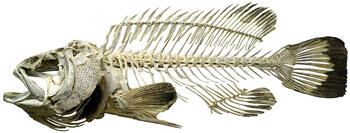
A skeleton of a grouper within the proposed order Stiassnyiformes. Melanie Stiassny/AMNH
"The spiny rayed fish are a massive problem for morphologists," says Stiassny. "In 1993, I suggested that the grey mulletat loose ends taxonomicallywas related to guppies, damselfish, and other species. What is really cool is that the new molecular survey found strong support for this idea."
Colleagues often use the names of scientists to honor their discoveries. Mark Siddall, for example, used DNA analysis and electron microscopy to upend what was known about a parasite that infects fish; Myxobolus siddalli is not related to single-celled protozoans but to jellyfish and other cnidarians. Mammalogist Rob Voss also has a parasite named after him. As he muses, "So far, just one fossil mouse and one filarial parasite have been named for me. I think both were well-intentioned, but with parasite names, one never knows!"
When it comes to scientists studying animals encased in exoskeletons, the numbers of species bearing a scientist's name jumps, although this is not surprising since arthropods are such a large portion of the world's biota. Off the top of his head, wasp taxonomist Jim Carpenter can recall a Vietnamese stingless bee and five species of potter wasps named after him, while Toby Schuhhas had three genera of true bugs named for him: the neotropical groups Schuhocoris, Schuhella, and Schuhgasterall based on specimens he collected. Norm Platnick and Jerry Rozen, who have been in the Division of Invertebrate Zoology for 35 and 49 years, respectively, each have about two dozen species that bear their names. Platnick, for example, connected a genus of tarantulas known only from female specimens to a group of small, bizarre, and enigmatic males (each species is highly sexually dimorphic), and the bee Zikanapis rozenorum was one of the species named for both Rozen and his wife to highlight their shared fieldwork.