Amber
Curator-in-Charge: David Grimaldi([email protected])
Collections Assistant: Aga Pierwola
View the list of Amber Fossil Types at the Museum.
- For loan requests: Go to the Loans page and fill out the request form.
- For visitation requests: Go to the Visits page and fill out the request form.
- Donors: Please refer to the Invertebrate Zoology policies regarding the deposition of material.
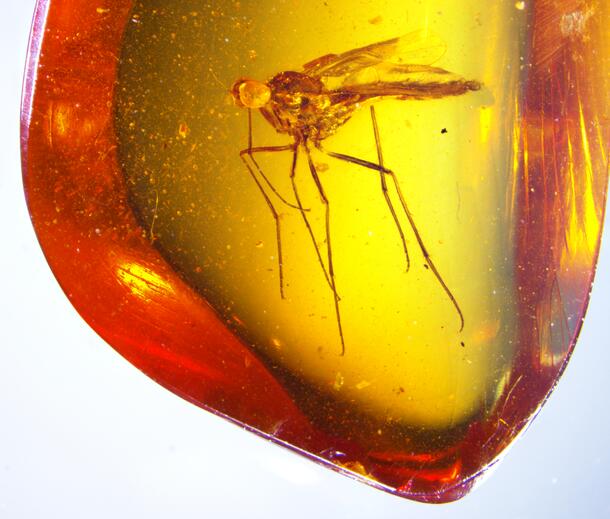
Insects evolved at least 420 million years ago, and their rise to become the most diverse and ecologically important class of terrestrial animals is a story beautifully recorded in the fossil record.
AMNH never had a researcher of fossil insects prior to 1986, but the collections have grown enormously since David Grimaldi joined the staff (Evolution of the Insects). Indeed, the collection of amber fossils is arguably the most important such research collection in the world, being strong for both the Tertiary and Cretaceous. Because amber preserves with microscopic fidelity, it allows uniquely accurate estimates of the amount of evolutionary change over millions of years. Arthropods are the most diverse life forms in amber, though plants and rare soft-bodied invertebrates can also be preserved.
Among the first significant acquisitions by the Museum, made during the early 20th century, were insects in Late Eocene paper shales from Florissant, Colorado (still stored in the Division of Paleontology), those in Eocene Baltic amber (with some of W. M. Wheeler's ant types), and a large amount of copal (subfossil resin) from Zanzibar that contains myriad insect inclusions.
Later, the museum received a large collection of fossils from the Aptian-aged Crato (Santana) Formation of Brazil (mid-Cretaceous, ca. 110 Ma), containing some 3,000 terrestrial arthropods. The Crato insects are mineralized replicas preserved in limestone, and constitute one of the largest and most diverse deposits of Cretaceous insects. AMNH holds pre-eminent collections of Cretaceous amber, a total of some 10,000 pieces, from the Cretaceous of Lebanon (c. 125 Ma), Myanmar (c. 100 Ma), Alaska (95 Ma), New Jersey (c. 90 Ma), and Alabama (ca. 85 Ma).
Collectively, these specimens provide a unique archive of insect evolution during a time when angiosperms radiated. Though the Baltic amber collection is not as large as some European collections, it contains many rare taxa, particularly of Hymenoptera. AMNH houses the Baltic amber collection of Jens-Wilhelm Janzen, rich in parasitoid wasps that are rare in this amber (such as Chalcidoidea), and the world's largest collection of fossil bees, which are very rare in Baltic amber and were methodically assembled by M. S. Engel. The Museum also houses a very diverse collection of amber fossils from the Miocene of the Dominican Republic, with smaller collections of amber from the Paleocene of Wyoming, Eocene of Arkansas, Miocene of Mexico, and other localities. As of 2009 there are almost 400 holotypes in the amber collection. The breadth of the amber collection is due in large part to Mr. Robert G. Goelet, trustee and Chairman Emeritus of the AMNH, who funded purchase of collections and sponsored field work.