The Titanosaur
Part of Orientation Center.
 Alvaro Keding/© AMNH
At the time, the species was so new, that it had not yet been formally named by the paleontologists who discovered it.
The scientific name, Patagotitan mayorum, was announced in August 2017. The moniker was inspired by the region where this new species was discovered, Argentina’s Patagonia (Patago); by its strength and large size (titan), and by the Mayo family on whose ranch the fossils of this new sauropod species were excavated (mayorum).
Paleontologists suggest that Patagotitan mayorum, a giant herbivore that belongs to a group known as titanosaurs, weighed in at around 70 tons. The species lived in the forests of today’s Patagonia about 100 to 95 million years ago, during the Late Cretaceous period, and is one of the largest dinosaurs ever discovered.
The remains were excavated in the Patagonian desert region of Argentina by a team from the Museo Paleontologico Egidio Feruglio led by José Luis Carballido and Diego Pol, who received his Ph.D. degree in a joint program between Columbia University and the American Museum of Natural History.

The Titanosaur cast grazes the gallery’s approximately 19-foot-high ceilings, and, at 122 feet, is just a bit too long for its home. Instead, its neck and head extend out towards the elevator banks, welcoming visitors to the “dinosaur” floor.
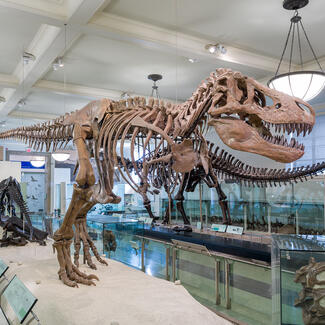
Generous support for The Titanosaur exhibit has been provided by the Susan S. and Kenneth L. Wallach Foundation.