![]() |
![]() |
![]() |
![]() |
![]() |
![]() |
![]() |
![]() |
|
What kind of dinosaur laid the eggs at the nesting site? |
||
|
|
A
conversation with Dr. Luis Chiappe, continued.
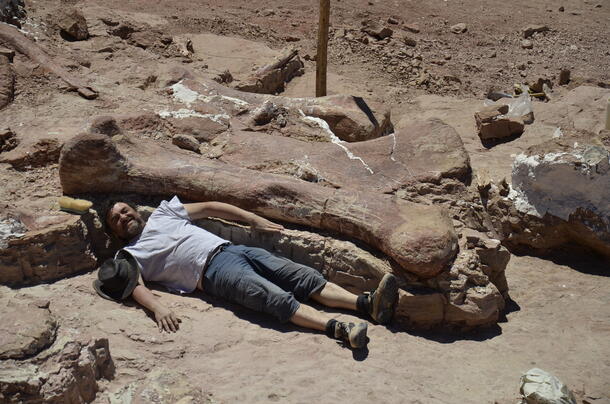
We had bones, we had skin, we had a tremendous nesting ground, but we didn't know definitively what kind of dinosaur we were finding because we were not finding adult dinosaurs. We guessed that our dinosaurs were sauropods. Those large relatives of the Apatosaurus and Barosaurus that we have on display at the museum, or what some people used to call Brontosaurus, had a large body, elephantlike legs, a long neck, a small head, and a long tail; and they were plant-eating dinosaurs. We guessed that those eggs and embryos were of sauropods because they were large and round, roughly five to six inches in diameter, and similar eggs had been found in Europe, in Asia, and in other places in South America, and they had always--or often--been referred to as sauropods. But the ultimate proof was still missing. In order to say that an egg belongs to a particular dinosaur, you need to have an embryo inside that egg that has the anatomical characteristics that define that particular type of dinosaur. None of the eggs that had been regarded as sauropods contained any embryo. So those assignments, those associations to a particular type of adult dinosaur, had been made on a more circumstantial type of evidence, such as finding a sauropod nearby. Or these eggs are large, they must be of a large dinosaur, so they must be of a sauropod. It was a very nice surprise for us when we came back to the museum and these specimens were prepared (by a preparator who worked with a needle and removed the clay and rock that were surrounding the bones and skin), and we found out that the embryos [from Auca Mahuevo] have the anatomical characteristics of sauropod dinosaurs. We were the first scientists to present conclusive evidence of the first sauropod embryo ever known. And therefore, immediately, by default, we knew that the entire nesting site had been a gathering place of these giants. |
|
|
What caused the death of these dinosaur embryos? |
||
|
|
A conversation with Dr. Luis Chiappe, continued. Based on studies that our geologist, Lowell Dingus, did at the site, we knew that the dinosaurs had nested fairly close to a river in the floodplain. Obviously, all the embryos that we found were not part of a natural rate of embryonic mortality but must have been the result of a catastrophe. Based on the study that Lowell did on the rocks, we can say with confidence that the catastrophe was a flood. Let me paint the picture for you. The dinosaurs would gather in this place every season to nest and lay all their thousands of eggs. Normally, those embryos would hatch out of the eggs and become larger dinosaurs. Essentially an embryo would hatch at roughly 12 to 15 inches and grow to be an adult of 40 to 50 feet in length. But from time to time, the river would flood. And the flood would cover the nesting ground completely with water and mud, and the embryos would die inside the eggs. A very sad season for the dinosaurs but an excellent season for us. Because of the layer of mud that covered the eggs, the eggs were protected from scavengers and also from disintegration by decay. They fossilized and they remained well preserved. |
|
|
Do you have more than one flood represented? |
||
![]() |
A conversation with Dr. Luis Chiappe, continued. If we look at a cross-section of the rock layers, we have eggs over a horizon of about 15 feet in depth. And it is quite clear that the dinosaurs didn't lay 15 feet of eggs at once. So this clearly represents a number of seasons--seasons in which they would go back, and back, and back, to exactly the same site. |
|
|
Are there people living in this region? |
||
|
|
A conversation with Dr. Luis Chiappe, continued. There are a few ranchers living around. The people who live there are rugged, very rugged. They raise goats and horses, and that's pretty much all they do. This is a place where pumas are still abundant. They come down from the hills and may kill 30 or 50 goats in a day. I'll give you an example of what I mean by rugged. One of our hostesses, a woman of about 70 years old, rides her horse every morning to get the goats, and then of course she works with the goats, butchers whatever creature is around for dinner. In her free time she goes out into the mountains to chase pumas. She told us a story in which she finally killed a puma, after chasing it for a while, with a gaucho. The puma was wounded, but still, a wounded puma, I wouldn't want to be very close to it. So this lady killed a puma with a club. I believe her. So, pretty rough people. |
|
|
What are the next steps in your research? |
||
|
|
A conversation with Dr. Luis Chiappe, continued. The specimens we brought have undergone the first round of study. I want to do a specific analysis of the composition of the skin. I want to know in more detail how the skin got preserved. We are also going to study the diversity of eggshells and egg shapes that we have. But in terms of the actual embryos, the bones have been studied. Now I have funds from National Geographic and InfoQuest to go back and do more prospecting. We'll see what happens. I would say that right now, the most intriguing things are going to be solved at the field. When we go back in March, we want to expose a large area of eggs. Many of the eggs are still covered by mud and silt, by the clay that entombed them. After uncovering a large area, maybe of a surface of 100 feet by 30 feet or something like that, and mapping each egg, we'd like to look at the pattern of egg laying and determine whether nest, or in smaller nests, or in a more irregular pattern. So in order to answer those questions, we need to go back to the field, uncover the eggs, map the area, see how the eggs were laid. And then of course we will continue to collect more embryos and prepare and study them. |
|
|
|
||
© amnh.org/copyright