Permanent Exhibitions - Dioramas
 
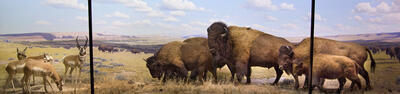
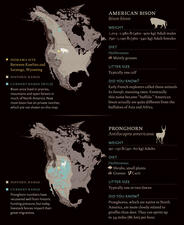
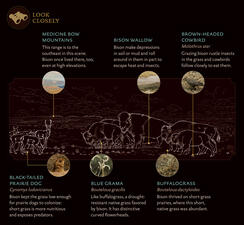
Bison & Pronghorn
Virtual Diorama
Behind the Scenes
The Art of J. P. Wilson
 
Sioux Buffalo Hunt
 

Sioux Buffalo Hunt by George Catlin.

The near extinction of the North American plains bison took place during the latter half of the 19th century and culminated in the mass slaughter of millions of animals during the early 1870s. The many tribes of the plains, which included the Sioux, Cheyenne, and Arapaho, had long hunted the plentiful bison not only for food, but also to make clothing, tools, and shelter. The bison was an integral part of the Plains Indians' lifecycle and was honored as a spiritually important animal.

Bison Robe

Many factors contributed to the decline of the bison, but one of the earliest was the introduction of the horse, and later the gun, into Plains Indian cultures. Though many more bison could be killed by mounted and armed hunters, the overall bison population was likely not threatened by Indian's hunting for their own needs. However, the stage was set for more dramatic losses once trading organizations such as the American Fur Company began to purchase bison skins during the 1830s in lieu of the dwindling supply of beaver pelts. More and more bison were soon being killed so that their skins could be traded for firearms, gunpowder, textiles, and other goods.

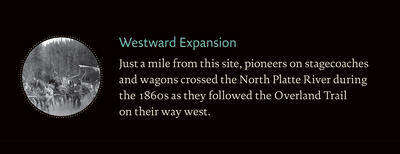
The wholesale slaughter of bison on the Great Plains peaked in the years following the Civil War. During this time the ecology of the American West was radically changed by a great influx of white settlers. New railroad lines built during the 1860s not only carried large numbers of people to the plains in search of inexpensive land, gold, and adventure, but were also used to ship bison hides back east. Bison hunters, such as William “Buffalo Bill” Cody, earned their living by killing bison for their hides or to feed railroad workers. Many bison were killed purely for sport or for their tongues alone, which were considered a delicacy. Bison hunting was also justified by some as a way to aid the U.S. government's struggle against the Plains Indian tribes by destroying their primary food source. By the turn of the century there was only one wild herd of bison left in America, located in the remote backcountry of Yellowstone National Park.

Indian Hunting Scene

In 1886 the Smithsonian Institute sent zoologist William T. Hornaday to the West to collect bison for preservation purposes. Hornaday, troubled by the scarcity of bison he saw on his trip, began to gather support upon his return back east for a movement to protect the bison. In 1905 the American Bison Society was formed for this purpose with Hornaday as its president and Theodore Roosevelt as Honorary President.

Due in large part to the groundwork laid by Hornaday, Roosevelt, and others, there are about 300,000 bison in North America today. The American bison is currently listed by the International Union for the Conservation of Nature and Natural Resources as a “Lower Risk: Conservation Dependent” animal. However, the plains bison, though making a strong comeback, is still threatened by factors such as disease, genetic hybridization, and shrinking natural environments. In order to ensure the bison will prosper in the future, it is important that conservation efforts continue to protect this great symbol of the American West as well as its environment.


Michael J. Novacek
AUDIO: The Story of the American Bison
In this lecture, Dr. Michael J. Novacek talks about what the story of the bison can teach us, and explains what paleontology, the study of the past, can tell us about the future. You will need to have the Real Player installed on your computer to hear this audio file. PLAY >


SEARCH SITE MAP FAQ COPYRIGHT INFO PRIVACY POLICY ROSE CENTER CONTACT US SIGN UP FOR AMNH ENOTES