Petrology Collection
The rock, or petrology, collection consists of several thousand hand samples and a number of drill cores from around the world. This collection is primarily used for research. In general, samples are available for loan to researchers outside the museum. Most of the collection is concentrated in specific varieties of rock, some of which are detailed below.
Layered Mafic Intrusions (igneous)
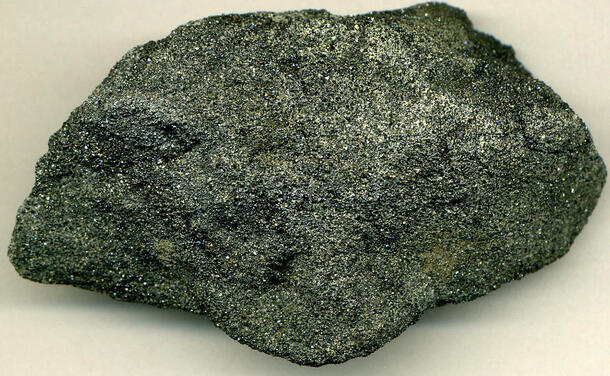
Layered mafic intrusions are large igneous bodies that are layered similarly to sedimentary rocks. Many are widely used and mined for precious metals such as chromium, platinum, palladium, and nickel, and are extremely important natural resources. This collection consists largely of samples and drill cores from the Bushveld Complex, South Africa, the Stillwater Complex, Montana and various other bodies including Skaergaard, Greenland, Noril'sk, Russia and the Great Dyke, Zimbabwe.
Mantle Xenoliths (igneous)
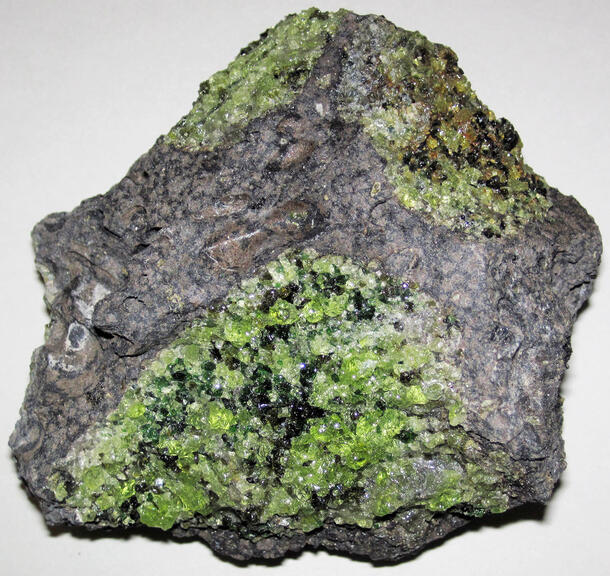
Mantle xenoliths are ultramafic rocks found in the crust of the Earth, but were formed within the Earth's mantle. This collection contains mantle xenoliths from localities worldwide, including samples of basalts and kimberlites. Many samples remain unstudied. Our collection includes samples from San Carlos AZ, South Africa and Australia, as well as the Jagoutz Collection of xenoliths.
Volcanics & Ocean Crust (igneous)
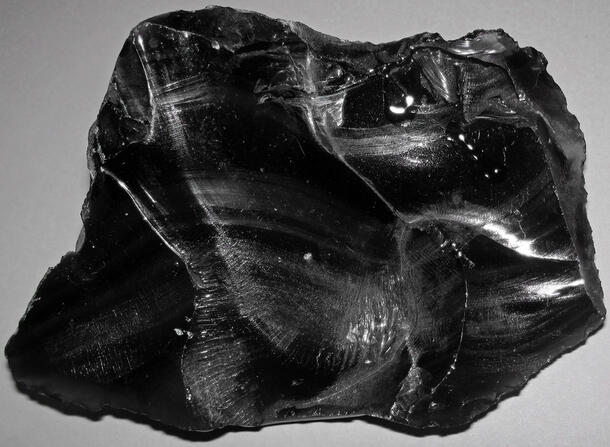
This collection includes many different kinds of rocks that solidified on the surface of the earth. These include volcanic basalts, porphyry (volcanic rocks with large crystals in a fine-grained matrix), obsidian, and ash from recent and historic eruptions including samples from Hawaii, Mt. Pelee, Vesuvius, Italy and Massif, France. The Hawai'i and Oman Ophiolite drill cores are part of this collection, as are the Clague collection of oceanic basalts and hydrothermal vents, and the Wheeler Collection of igneous and metamorphic rocks from the Labrador Coast, including the founding collection of the Kiglapait Layered Intrusion and material from the Nain Anorthosite Project, donated by Tony Morse.
Samples of various volcanic rocks are available for research from the following locations (research proposal required):
- Hawaii
- Zabargad, Egypt
- Mt. Pelée, Martinique
- Newer Volcanic Field, Australia
- Vesuvius, Italy
- Mt. St. Helen's, WA
- Arizona
- Pinacate, Mexico
- New Mexico
- Mt. Lassen, CA
- Soufriere, St. Vincent
- Massif Central, France
Hawaii Scientific Drilling Project
The museum serves as a repository for the recovered drill core from the Hawaii Scientific Drilling Project (HSDP). Our collection houses the active and archive cores of the 1,056 m pilot hole drilled in 1993/1994 (HSDP 1) and the 3,109 m first phase hole completed in 1999 (HSDP 2). These cores are available to any interested researchers for sampling. Maps of the lithologic column, a complete core log, summarizing data and photographs of each box of core are available via the HSDP website and on CD to aid investigators in finding potential sample locations along the core. Sampling must be done on-site and under the supervision of the collections manager.
Special Collections
The Hall of Planet Earth contains over 168 samples of varying composition and origin, including numerous large samples, each chosen to illustrate fundamental properties of the earth and how it functions. Samples are generally available for study and many are available for teaching purposes.
 Denis Finnin/© AMNH