New Space Show
The Search for Life:  Are We Alone?

Century after century, people have looked to the stars with questioning and dreaming minds. Sailors and farmers have found guidance; poets and lovers, inspiration; scientists and scholars, answers. But all of them, and everyone who has ever looked heavenward, have also found questions in the cosmos. Perhaps the most common question pondered over thousands of years is, "Are we alone?"

Does life exist anywhere else in the universe? Ancient mythologies and contemporary science fiction have presented imaginative possibilities, but how does modern science approach this question? The Search for Life: Are We Alone? at the Rose Center for Earth and Space begins to answer this intriguing question in a breathtaking new Space Show narrated by Academy Award–nominated actor Harrison Ford. Answers begin to emerge as we consider these newly revealed facts:

  • Life on Earth can thrive in environments previously thought hostile and inhospitable;


  • There are planets outside our solar system, a fact only recently confirmed; and,


  • The processes that created our Sun and solar system—and ultimately allowed life to develop and flourish on Earth—are the same processes that have created every other star and planet in the Galaxy and continue to do so today.
Europa and Jupiter

Europa and Jupiter


An exhilarating journey from the depths of Earth's oceans and onward to planets outside our solar system, The Search for Life depicts how scientists are searching, as never before, for signs of life beyond our world.

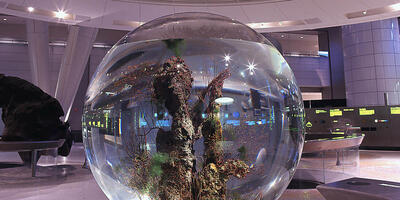
Premiering in March 2002, The Search for Life is the centerpiece presentation of the Frederick Phineas & Sandra Priest Rose Center for Earth and Space of the American Museum of Natural History. Presented in the Hayden Planetarium Space Theater, which houses the world's largest virtual reality simulator, The Search for Life uses scientific data to create dazzling visualizations and animations—many developed for this show—that allow us to travel through space and time and witness phenomena as never before.


The Search for Life will take visitors on a once-in-a-lifetime journey to:

  • The depths of Earth's oceans—Just 25 years ago, scientists discovered life thriving in the most extreme of terrestrial environments, more than a mile below the ocean surface. Here, in perpetual darkness and scalding temperatures, and under intense pressure, the presence of microbes, tube worms, clams, crabs, and skates indicates that the conditions for life are more widely varied than was previously believed.


  • The planet Mars—Actual imaging data from NASA's Pathfinder mission creates a 3-D experience that allows us to take a walk on the fabled Red Planet, where liquid water, one of the essential harbingers of life as we know it, may lie under the surface.


Mars

Mars, the Red Planet

  • Europa, one of Jupiter's four giant moons—Europa is encased in an icy crust that shows signs of covering a deep ocean of liquid water. Hot springs on the floor of that ocean may well support life.


  • A stellar nursery—Galaxies, including our own Milky Way, are "factories," recycling matter to manufacture stars and planets within a swirling cosmic soup of gas and dust. Groundbreaking scientific simulations developed by an astrophysicist at the American Museum of Natural History will depict this complex and awe-inspiring process.


  • An exoplanet, a planet outside our solar system—Less than a decade ago, scientists had no knowledge of planets outside our solar system because we had no way to detect them. Technology has now enabled scientists to identify nearly 100 exoplanets in our Milky Way Galaxy. More are being discovered at an astonishing rate. In fact, planets likely outnumber the stars. These exoplanets offer the tantalizing possibility of life flourishing elsewhere.

We are at the dawn of a new age of exploration. Our Galaxy, along with the awesome universe beyond, contains countless worlds yet to be discovered and explored. How many of them may harbor life? Join us at the Rose Center for Earth and Space as we explore the intriguing possibility that we may not be alone.

Buy tickets online or by calling 212-769-5200.


NASA

The Search for Life: Are We Alone? has been developed by the American Museum of Natural History in collaboration with the National Aeronautics and Space Administration (NASA). It was written by Ann Druyan and Steven Soter, with music by Stephen Endelman.

   
Swiss Re

The Search for Life: Are We Alone? is made possible through the generous support of Swiss Re.

Search for Life: Are We Alone? script (pdf, 57kb).


SEARCH SITE MAP FAQ COPYRIGHT INFO PRIVACY POLICY ROSE CENTER CONTACT US SIGN UP FOR AMNH ENOTES