Ahnighito
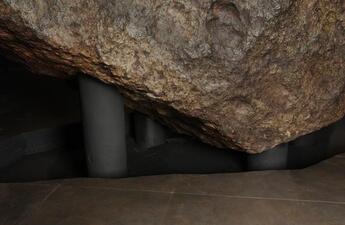
Part of Hall of Meteorites.
 M. Shanley/© AMNH
The Cape York Meteorite is so heavy that supports from the largest of the three pieces go straight down to the bedrock beneath the Museum. The massive meteorite comes from the center of a small asteroid that broke apart.
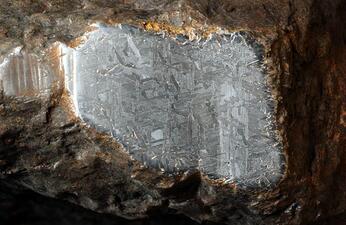
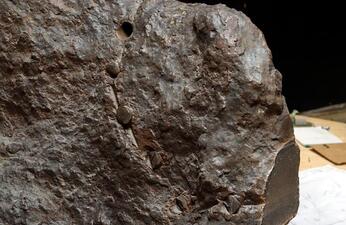
When you touch the 4.5-billion-year-old Cape York Meteorite, you are touching an object that is nearly as old as the Sun. Discovered in 1894 in Greenland, this iron meteorite slammed into Earth some 10,000 years ago.
Thirty-four Tons of Iron
This huge piece of iron, known as Ahnighito, is actually just one portion of a much larger meteorite that fell to Earth from space. It landed in Greenland thousands of years ago, before any people lived there. The original meteorite, called Cape York, was initially around 200 tons—at least six times the size of Ahnighito—before it broke apart in the atmosphere. Two other fragments of Cape York can also be seen in this hall. At 34 tons, Ahnighito is the largest meteorite on display in any museum.
The Top Five Largest Meteorites
1. Hoba: 60 tons, found in Grootfontein
2. Chaco: 37-39 tons, (fragment of Campo del Cielo), found in Chaco Gualamba, Chaco, Argentina
3. Ahnighito: 34 tons, found in West Greenland, Greenland
4. Bacubirito: 24 tons, found in Sinaloa, Mexico
5. Armanty: 22 tons, found in Xinjiang, China