ARTHUR ROSS HALL OF METEORITES
WHAT IS A METEORITE?

FRAGMENTS OF CAPE YORK

Cape York meteorite
Cape York meteorite
© AMNH

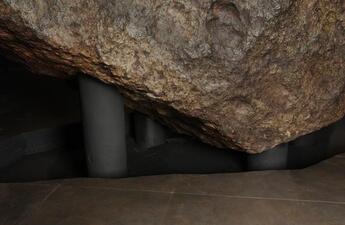
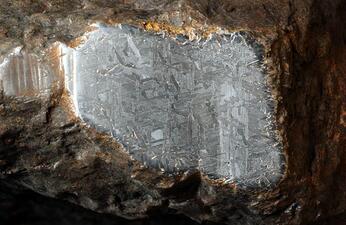
A total of seven fragments of the huge Cape York meteorite have been identified; three are on display here. Ahnighito, the large mass in the center of the room, is the biggest piece of Cape York ever discovered. The fragments known as the Woman and the Dog are considerably smaller and were found near each other, roughly seven kilometers (four miles) from Ahnighito.

When meteorites enter Earth's atmosphere, they are typically traveling at tens of thousands of miles an hour. At such high speeds, friction with the air causes the surfaces to heat up and melt until the meteorites eventually shatter.

GREENLAND'S METEORITES

Watch The Journey of Cape York video which tells the story of the three Cape York meteorites on display in the Hall.
(Get RealPlayer.)

The three fragments of Cape York on display—Ahnighito, the Woman and the Dog—were found in the Melville Bay region of northwestern Greenland. The Woman and the Dog were originally on the mainland. Ahnighito was located on an island just offshore.

Three other Cape York fragments have been found in Greenland and one in Canada. No crater associated with any of the Cape York fragments—including the largest one, Ahnighito—has ever been located. Some scientists speculate that Cape York fell when this area of Greenland was blanketed by a thick sheet of snow and ice.

METALWORK

Cape York meteorite
Cape York meteorite: Woman (left); Dog (on pedastal); and Ahnighito (background)
© AMNH

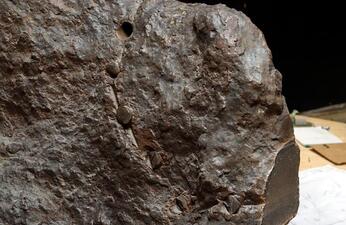
The 407-kilogram (897-pound) fragment of Cape York known as the Dog was extensively hammered by Inuit workers—just like the fragment called the Woman, which was found about 30 meters (100 feet) away. Both of these fragments were hammered much more than Ahnighito; experts are not entirely sure why.

According to arctic explorer Robert Peary, who located the three fragments of Cape York now on display in this hall, native Greenlanders recounted a story that these meteorites were once a sewing woman and her dog who were cast from heaven by an evil spirit. Ahnighito was the tent that sheltered them. Some people have speculated that this story may have been invented for Peary's benefit.

HAMMERING AWAY

Although iron meteorites are incredibly hard, the Inuit people successfully chipped off pieces of the fragment known as the Woman using hammerstones made of basalt. The iron was then used to make tools such as knives and harpoons.

When explorer Robert Peary located the Woman in 1894 with the help of an Inuit guide, some 10,000 hammerstones were scattered around the three-ton meteorite. Over the years, Inuit people had carried these basalt stones to the area from far away because the rocks found naturally around the Woman were too soft to break iron.

TOOLS FROM METEORITES

Few trees grow on the rugged arctic terrain of northwestern Greenland, so the native Inuit population long made tools and weapons out of such materials as walrus tusks and reindeer antlers. And until the mid-1800s, the primary source of metal for their knives, harpoons and spear points was iron from meteorites.

BACK