Storage Organization
 © AMNH
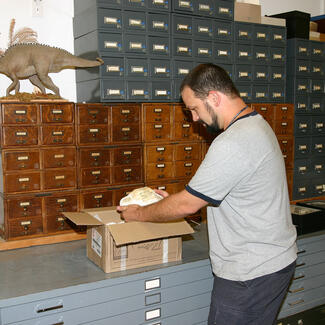
Decisions on how to organize collections are generally a compromise between the physical space available for storage, the resources available, and how a collection is curated and used.
Taxonomical Organization
The most common way to arrange specimens is taxonomically. Specimens are arranged according to taxonomic hierarchy. Once the lowest level of taxonomic organization in the collection has been reached (e.g., genus or species), specimens are grouped by geographic locality, or by geological age. This method tends to be preferred for collections where the heaviest usage is for systematic or phylogenetic studies.
Stratigraphical Organization
Alternatively, paleontological collections can be arranged stratigraphically: specimens from rocks of the same formation are housed together. Within each stratigraphic formation, specimens are then grouped by taxonomy. This has the advantage that it is easier to study taxonomically diverse members of the same biota, or all of the members of a taxonomic group that existed at the same time or place.
Additional Concerns
Certain sections of the collection may deviate from the overall plan. For example, if the main significance of a sub-part of the collection is historic, rather than purely scientific, it may be appropriate to house it as a separate unit. Collections of material that have yet to be identified may need to be housed separately from the main collection, as may material that is used primarily for teaching purposes, or for a specific, on-going research project.
Finally, type specimens are a particularly important sub-category of material in many collections, and it may be useful to either house them separately or to give them a visible designation to highlight their presence. Where such sub-collections exist, they need to be clearly labeled, both in the collections databases and wherever they are housed physically.
Ultimately, the most important factor in arranging the collection is that it should be usable. A visitor to the collection not only needs to be able to quickly find individual specimens, but also to be able to browse the collection in a meaningful way. Ultimately, developing and implementing a consistent rationale for the arrangement of the collection probably is more important than the particular actual arrangement that is chosen.
These Collection Management resources were originally developed in 2007 with the support of the National Science Foundation (NSF).
