Research Projects
Alvaro Keding/© AMNH
Each year, there are 20 projects covering a diverse range of topics in the physical and life sciences represented at the Museum, from astrophysics to invertebrate zoology. Students collaborate in teams of 2-3 with a mentor on a selected project. The project lineup evolves annually. Students identify their top 5 choices and get matched with one mentor. Each team meets twice a week after school and the exact schedule is determined within each small group. But the mentor’s availability takes priority. See examples below of recent projects.
Browse Recent Projects:
I can mentor on:
Topics: Evolutionary Biology, Taxonomy & Systematics
Department: Paleontology
Bio: My name is Xavier Jenkins, and I am a paleontologist and postdoc at the American Museum of Natural History. I spent most of my childhood in Arizona, and I double majored in Anthropology and Biology at Arizona State University (go devils!). I moved to Idaho to pursue my PhD at ISU, and during my graduate studies there I started my family. I am a huge fan of dungeons and dragons, PC gaming, and espresso!
Project Title: The Rise of Reptiles: 3D reconstruction of Paleozoic reptile anatomy using micro-computed tomography
Background: Reptiles first appeared over 300 million years ago during the Carboniferous Period, a time when land was ruled by early relatives of amphibians and mammals. By the Triassic Period, reptiles like dinosaurs and marine reptiles had become the dominant terrestrial vertebrates, but how they got there is still a mystery. In this project, we’ll study CT scans of ancient reptile skulls to explore hidden parts like the braincase, ear, and palate. These areas can help us figure out what made reptiles different from their closest relatives and how they rose to dominate the land.
Research Question/Goal: How was the neuroanatomy of early reptiles different from their close relatives? What were the sensory capabilities (e.g., vision, hearing) of these animals?
Skills students will build:
- Anatomical knowledge, particularly concerning the braincase and cranial nerves
- Segmentation and 3D reconstruction using software such as Dragonfly
- Understanding scientific literature
- Scientific collaboration and communication
I can mentor on: Any day, Monday-Friday
Topics: Bioinformatics, Conservation, Cultural Anthropology, Taxonomy and Systematics, Ecology
Department: Ichthyology
Bio: I am Ryan Thoni, a recent NYC transplant from California. I got my Ph.D. studying fishes of the Himalayas, and I love to travel there whenever I can! I also love spending time outdoors, and am learning how to adjust to make that make sense in the city. Now that I am here I am basically touring the city and state on my bike one pizza slice at a time. I love going to concerts, fishing, and I grow a forest of Thai basil in my apartment for all the Thai dishes I cook!
Project Title: Using Museum Specimens to Measure Microplastics Over on the New York Landscape
Background: We have at our disposal one of the biggest collections of historical fish specimens in the world! Last year we looked through time, but now we can see where they are concentrated the highest. Urban? Rural? Marine?
Research Question/Goal: Is there any spatial influence on microplastic levels in New York fishes?
Skills students will build: The Ichthyology Collection, microscopes, dissecting tools, microplastic identification skills, protein digestive chemicals (KOH), PPE, database use, literature libraries/databases, teamwork skills, and hopefully the use of maps/GIS.
I can mentor on: Monday-Thursday: 4-7 pm
Topics: Bioinformatics, Genetics & Genomics, Evolutionary Biology
Department: Genomics
Bio: After receiving my PhD in 1999, I conducted research at University College London and the Joint Genome Institute (near San Francisco, CA). I joined the Genomics Lab at AMNH in 2007 and have been mentoring SRMP students for the past fifteen years. I live in Clinton Hill, Brooklyn.
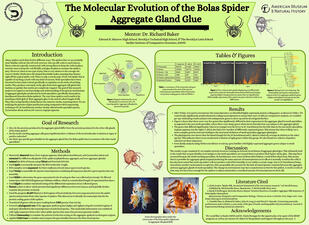
Project Title: Genomic Evolution in Tropical Tent-Web Spiders
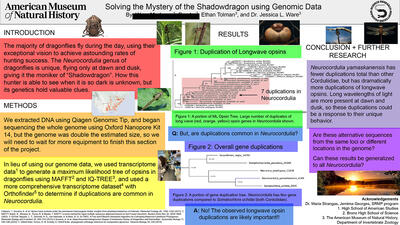
Background: Spiders are one of the dominant predators of insects on the planet and are well known for catching their prey with silk webs. They have evolved several different types of webs (e.g. cobwebs, orb-webs, funnel webs) that utilize an array of different types of silk (some strong, some stretchy, some sticky) that are specialized to capture certain types of prey. One of the fundamental questions in spider biology involves understanding what transitions in web architecture have occurred during the evolution of spiders and what genetic changes are associated with these transitions. In this SRMP project, we will study the genetic changes associated with the evolution of the tent web in Cyrtophora spiders. These spiders are semi-social and have evolved a new web type from their ancestors which use an orb-web.
Research Question/Goal: The primary research focus of this project will be to ‘annotate’ the genome of Cyrtophora citricola. This means identifying all the genes that exist within this species and figuring out in what glands and tissues these genes are used. As part of the transition to a tent web, Cyrtophora spiders have lost two primary silk glands that make a specific type of silk used by orb-weaving spiders. This means that many of the genes that function exclusively in these glands are also likely to be lost from the genome. We will identify what genes have been lost and if a suite of new genes has evolved as a result of this transition to a new web type. In addition to helping us understand how tent web spiders have evolved, this information will also provide valuable insights about orb-web silk function because the lost genes indicate a specific functionality.
Skills students will build: This research will involve bioinformatic computer analysis and wet lab molecular techniques associated with both RNA and DNA sequencing. Most of the first semester will be spent in the molecular lab doing RNA preps on different Cyrtophora tissue and most of the second semester will be spent conducting computer analysis of the sequence data collected in the fall.
I can mentor on: Mondays and Wednesdays (preferably) between 4 and 7 pm
Topics: Genetics & Genomics, Taxonomy & Systematics, Conservation
Department: Ichthyology
Bio: I am from Brazil, and I lived most of my life in the city of Rio de Janeiro. Since I was a child, I was interested in nature and used to hike in the forests near Rio searching for animals and photographing them. I also used to visit the Natural History Museum in Rio with my grandfather. Currently, in my free time, I love to play the bass and the guitar and listen to music. I love Brazilian and World music, but Jazz is the genre I am really into. Also, I have a special interest in the history of Africa, a fascinating continent with amazing landscapes, cultures and biodiversity. During my lifetime I lived in two other countries in addition to Brazil and the United States, Belgium and South Africa. In addition to English and Portuguese (mother-tongue), I speak Spanish, and I can understand and read French. Another passion is to follow soccer and other sports, particularly the club I support in Brazil, Flamengo. When I am back in Rio, I always go to the Maracanã stadium with friends. I like to eat any kind of food, but I believe that there is nothing compared to a good barbecue. I think that one of the most interesting things in life is to be able to travel and meet different people and cultures.
Project Title: Barcoding, species delimitation, and phylogeography of Congolese fishes
Background: The Congo River basin is the second largest (4 million km2) in the world after the Amazon and harbors the highest diversity of freshwater fishes in the African continent with about 1,200 species. Despite recent efforts by ichthyologists to sample in the region, major knowledge gaps on the diversity and distribution of Congolese freshwater fishes persists. At the same time, the impact of human activities (logging, mining, and overfishing) is threatening this key region in keeping the world climate stable. To address this major challenge, the present project designed for the SRMP program, aims to better understand the diversity of species in the Congo and their distribution, with a focus on small species present in the Cuvette Centrale, a lowland rainforest region in the Congo where expeditions were taken in July-August 2024 and June-July 2025.
Research Question/Goal: This research will try to understand how small sized species that are considered to have broad distributions in the Congo Basin are able to keep gene flow within the entire distribution. Comparing the morphology and DNA barcodes of individuals from different populations will help us in answering the following questions: Is this species broadly distributed? Is there a possibility of having new species not known by science within what is considered to be a broadly distributed species? How do the different populations within a species keep gene flow with each other? The main goal of this research is to understand the distribution of small sized species that are considered to be broadly distributed in the Congo. This information is basic, contributing to the species identification and delimitation of its distribution limits which are critical to future phylogenetic, taxonomy, and biogeographical studies. The resulting knowledge from this research will contribute to understanding the biodiversity present in this region of the Congo basin and identify conservation priorities that should be taken for the conservation of the species and their ecological roles.
Skills students will build: Along this project the SRMP student will have the opportunity to develop different skills ranging from species identification based on morphological examination to editing pictures of live specimens which were taken in the field. Also, the use of genetic tools for species identification will be a main point during the research, that will result in the generation of many barcodes. To have the barcodes, the students will learn how to extract DNA, quantify it and in a later stage edit, align and run phylogenetic and phylogeography analysis. The development of GIS map editing capacity will also help in the preparation of the species distribution maps.
I can mentor on: Mondays, Tuesdays, Wednesdays, Thursdays between 1 and 6 pm
Topics: Bioinformatics, Genomics, Taxonomy & Systematics, Evolutionary Biology
Department: Herpetology
Bio: My name is Justin Bernstein and I am from New Jersey! I have lived in a variety of places: New Jersey, New York, Pennsylvania, Kansas, and Texas. I love spending my time with friends and family, regardless of the activity! One of my biggest hobbies is just being outdoors, specifically for hiking. Equally as important of a hobby…is trying out new restaurants and food establishments. Traveling to new destinations, either locally or far away internationally, is always an exciting time for me. And all of these hobbies are even better when you enjoy it with others!
Project Title: Species Diversity of Snakes on Luzon Island, Philippines
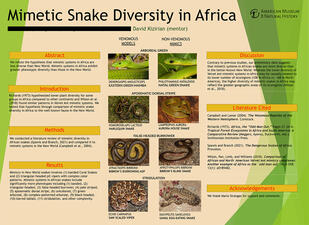
Background: Species diversity and conservation is directly dependent on understanding how many species exist on earth. However, to quantify how many species exist, we must study populations of organisms in-depth using a variety of scientific methods. This project involves looking at snakes from the Philippine islands, which are known to have a high number of species found nowhere else in the world. Using molecular data (DNA), this project will allow us to study snakes from the Philippines to identify if there are undescribed species that are unknown to science. The results of this project will answer questions about biodiversity and the evolution of reptiles in the Philippines and Southeast Asia.
Research Question/Goal: Are populations of the snake genus Cerberus in the Philippines representative of one or multiple species? What is their genetic diversity?This allows us to understand if there are undescribed species of snakes, unknown to science, in the Philippines, and how these populations have evolved over time.
Skills students will build: Computer coding (R and Bash), phylogenetics software (evolutionary biology analyses), understanding of scientific literature
I can mentor on: Monday to Thursday from 4 to 6 pm
Topics: Conservation, Ecology
Department: Center for Biodiversity and Conservation
Bio: I'm a Computer Scientist from Colombia working with the Center for Biodiversity and Conservation at the AMNH. Passionate about learning and using technology for positive impact, I enjoy exploring new ways of solving problems. When I'm not at work, you can find me playing soccer, watching movies, exploring the city, or trying new food. While I love Japanese cuisine, I also enjoy experimenting with Colombian recipes at home.
Project Title: Large Language Models to Enhance Information Retrieval in Conservation Practice
Background: Large Language Models (LLMs) are powerful tools that, among other tasks, can help summarize and explore large collections of information. For conservation, this is particularly valuable because LLMs enable researchers and educators to efficiently access massive datasets using natural language. This capability helps improve the quality of research and assists in making better-informed decisions.
Research Question/Goal: We want to make resources for teaching about Conservation more accessible. We will use data from the Museum’s NCEP (Network of Conservation Educators and Practitioners) collection. This repository contains open-access electronic modules covering diverse topics in conservation science for educators and trainers. The objective is to develop a pilot intelligent advisory tool that leverages LLMs to enhance the accessibility and utility of the NCEP module collection and similar information resources. This tool will test the LLMs' ability to efficiently summarize and explore the collection’s diverse resources.
Skills students will build: Python, Machine Learning, Large Language Models
I can mentor on: Monday, Wednesday, Thursday any time after 3:30 pm
Topics: Conservation, Ecology, Social Science
Department: Center for Biodiversity and Conservation
Bio: I am a Micronesian woman who grew up in the islands of Pohnpei and Guam. My mom is from the small island group of Chuuk and my dad is from Chicago. I enjoy exploring New York as a relatively new New Yorker, trying new foods and visiting other museums. I like outdoor activities like hiking and watersports (canoeing, kayaking, swimming). I love to read, and my favorite types of books, TV, and movies are horror and mysteries.
Project Title: Using new diversity measures to look at spatial changes in microbial communities.
Background: The US and French governments conducted nuclear bomb tests in remote Pacific Islands throughout the 20th century. Many of these islands continue to be inaccessible due to radiation concerns. Museum animal specimens (fishes, birds, shells) were collected from these or nearby islands before, during, and after testing. Some, namely fishes from Bikini Atoll and nearby, were collected to assess impacts from nuclear testing. However, it is unclear whether any of these specimens, some of them important food species, retain any radioactivity.
Research Question/Goal: 1. Can we detect radioactivity in fish specimens? 2. Are levels of radioactivity higher in fishes collected after atomic bomb tests compared to before and compared to collections from other locations? 3. What are the ecologies of the fishes collected (ie. benthic, lagoon, predator, corallivore, etc..)?
Skills students will build: Students will learn about the importance of museum collections for research, about testing in the Pacific and surrounding ethical concerns, designing replicable experiments and data collection, and about the natural history and ecology of Pacific reef fishes.
I can mentor on: Tuesday, Wednesday and Thursday, 4 to 7 pm
Topics: Conservation, Cultural Anthropology, Ecology
Department: Center for Biodiversity and Conservation
Bio: Born and raised in the rural Midwest, I have also lived on both U.S. coasts and overseas (mostly in India). Before turning scientist-teacher, I held jobs including but not limited to (in approximate reverse chronological order): birding guide, farm manager, voiceover artist, scuba resort divemaster, political journalist, tavern bouncer, sideline reporter, newspaper editor, sports photographer, tennis instructor, phone surveyor, grocery stock boy, corn detasseler and lawn mower. My happy place is in or just next to the ocean. I dive, paddle, fish and cycle; I have side hustles/obsessions with carpentry, Lego and DnD.
Project Title: Environmental history of the American eel (Anguilla rostrata)
Background: The American eel (Anguilla rostrata) represents a kind of occult, slippery “nature,” a historically mysterious species that continues to baffle scientists today. While the broad outlines of the eel’s multistage, bizarre, complex life cycle are known, far more questions than answers remain. From birth to death, American eel populations traverse an oceanic geography, one that stretches hundreds of miles from Sargasso Sea to tributaries and inlets far upstream in the United States and Canada. Along this great transit, the harbor and estuary of greater New York City — as a confluence of the Hudson, Bronx, Hackensack, Raritan and other rivers and their tributaries — has functioned as a gateway or hub for American eels past and present. Indeed, some eels can still be found here at some stage of their life at practically all times of the year. In this way, the American eel populations are both residents of and regular migrants to New York City, and a vital part of urbanized ecosystems with a long biological, ecological and sociocultural history predating European conquests and subsequent settlement and industrialization. Though greatly diminished from their precolonial abundance, they remain a species intertwined with the vitality of city waterways such that the health of eel populations also serves as a measure of how New York takes care of its own “nature.” In short, we might provocatively but also productively think of the American eel as simultaneously a Gotham eel.
Research Question/Goal: How has American eel abundance, geography and sociocultural importance changed in the greater New York harbor and estuary over time? Put another way, what is the environmental history of human- eel relations in this city?
Skills students will build: Students will learn all about: archival research (including in Museum collections), historical cartography, Geographic Information Science, critical political ecology theory
I can mentor on: Tuesday, Wednesday, Thursday afternoons after 4 pm
Topics: Physical Anthropology, Evolutionary Biology
Department: Vertebrate Paleontology
Bio: I’m originally from Westchester, but I lived in Boston for 5 years for school, and Queens for the last 4. In my free time, I like to knit, make jewelry, bake, and hang out with my cats. I also love to hike whenever I get a chance to leave the city. I’m not much of a cook, but I like trying new food spots around the museum. There are a lot of great restaurants nearby, but my absolute favorite afternoon snack is a cookie from Chip City!
Project Title: Exploring how movement and growth influence bone structure in humans and non-human apes
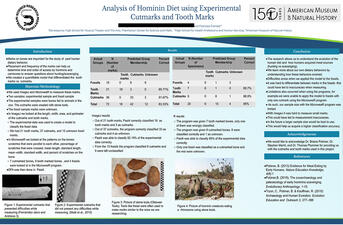
Background: Our bones can tell us a lot about how we move, grow, and even evolve. By studying the bone structures of humans and other apes, we can learn how factors like walking, development, and genetics shape our bones. This research also allows us to explore the similarities and differences between species, shedding light on our evolutionary past.
Research Question/Goal: How do different factors such as locomotion, development, and genetics affect bone structure in humans and non-human apes? We want to figure out how these factors influence the strength and shape of bones over time. This research is focused on the limbs (arms and legs, hands and feet).
Skills students will build: Students will work with advanced tools like micro CT scans and 3D surface scans to analyze bone structure. They will learn how to interpret and process imaging data, use software for 3D modeling, and assist in data analysis. By engaging with these technologies, students will develop skills in scientific research, data visualization, and the use of advanced imaging techniques.
I can mentor on: Tuesday, Wednesday, Thursday afternoons after 4 pm
Topics: Genomics, Conservation, Systematics
Department: Genomics
Bio: I have been interested in science and conservation for most of my life and am currently the Ancient Biomolecules Research Assistant at the Museum. I grew up outside St. Louis, Missouri spending my summers at the zoo and visiting many of the country's National Parks. I was also fortunate to spend a lot of time outdoors while in the Boy Scouts and continue to enjoy getting outside; whether that's in Central Park or upstate New York. In the past few years I have also gotten really into biking and love exploring the city on two wheels. Finally, I follow sports pretty closely and love talking all things NBA.
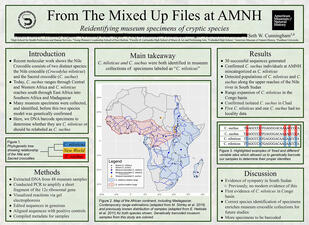
Project Title: Identifying crocodylian museum specimens and Ancient Egyptian crocodile mummies
Background: Recently, using genetics, the Nile crocodile (Crocodylus niloticus) was found to consist of two distinct species - Crocodylus niloticus and Crocodylus suchus. Currently, the sacred crocodile (C. suchus) is found throughout Central and West Africa, while the Nile Crocodile is found down Eastern Africa into Southern Africa and on the island of Madagascar. However, DNA from centuries old museum samples and Ancient Egyptian crocodile mummies indicate that both species used to co-occur in the Nile River of Egypt. Visually, these two species look extremely similar, so telling them apart is challenging, even for experts.
Natural History museums house millions of preserved organisms from all over the world. These collections include samples dating back hundreds of years and are used by scientists to better understand the natural world. Scientists use these specimens to identify new species, compare species to one another, catalogue the diversity of life on Earth, and to answer so many other interesting and important questions. All of this work is predicated on the museum collections having correct information. In our case, we now know that this is most likely not the reality. There are hundreds of museum samples collected as far back as the 1800’s that are currently identified as the Nile crocodile, that may in fact be this newly recognized species. Since the sacred crocodile has only been recognized for about a decade, all museum samples collected from Africa have been identified as the Nile crocodile until very recently.
Research Question/Goal: For this project we will collect tissue from museum samples currently identified as Nile crocodiles, as well as some Ancient Egyptian crocodile mummies. We will then genetically barcode these individuals to determine if they are in fact Nile crocodiles, or this newly recognized species, the sacred crocodile. Natural history museums will use this information to update their collections and we will use it to better understand when and where these two species occur(ed) across the African continent.
Skills students will build: This project will involve some work in the museum collections, lots of lab work, some bioinformatics, and some exploration of crocodile natural history. In the lab we will extract, amplify, and analyse DNA to identify species. This lab work will be conducted in specialized labs for getting DNA from historic and ancient specimens.
I can mentor on: Any day, Monday-Friday
Topics: Bioinformatics, Systematics, Conservation, Evolutionary Biology
Department: Invertebrate Zoology
Bio: Hi, I’m Rin (he/they), a 5th year PhD student at the American Museum of Natural History and Columbia! I grew up mostly in North Carolina but have lived in five countries. Beyond spending time with insects, I love to be in nature and travel, particularly with my friends and partner. Some fun facts are that I have been a vegetarian for around 15 years, and I prefer to commute by bike.
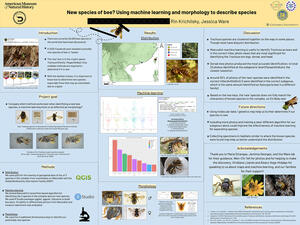
Project Title: Harnessing collections material to explore bee biodiversity patterns across space and time
Background: Natural history collections often house rare and undescribed fauna that span centuries and the globe! In the age of mass species loss, it is essential to use this comprehensive data source to understand how biodiversity patterns have changed over time for at-risk taxa. In addition to more than half of the species being vulnerable to decline, there are huge gaps in our holistic knowledge of bee diversity, as the US alone represents over 60% of online distribution records, more than the rest of the world combined. These data skews are not representative of actual species hotspots. This project aims to attenuate these gaps by using digitized collections data from Taiwan to assess the regional and temporal commonality of species. The results of this project will be reported to natural history collections around Taiwan, where the data originates, and inform both a checklist and conservation priorities. Students will get to analyze digitized images and label data from bees that range in color and size! This project has the potential for the discovery of new species and records, and will allow the students to connect their work with researchers internationally. Perhaps this will be their first time seeing bees that are blue, white, green, polka dotted, spiky, and they will come away with a better comprehension of this unique and essential group of insects.
Research Question/Goal:
- What bee species live in Taiwan?
- Which species are rare and common across space and time?
- How can we use this data to inform conservation projects and as a blueprint to fill in biodiversity gaps across the globe?
Skills students will build: Taxonomy and identification, label transcription, Excel, RStudio, photo editing, natural history collections (specimen handling)
I can mentor on: Any day, Monday-Friday
Topics: Bioinformatics, Taxonomy and Systematics, Genomics
Department: Ichthyology
Bio: I’m a marine biologist from Puerto Rico, now living in NYC after finishing my Ph.D. I love exploring the city’s parks and museums, trying spicy food, and attending baseball games. I’m a big fan of VR gaming and comic books, and I’m always experimenting with new recipes in the kitchen. I ride my bike everywhere. I’m passionate about science communication and love making videos about why different fishes are so cool. Even though I don’t eat fish myself, my hidden talent is being able to tell you exactly what different species will taste like.
Project Title: Resolving Species Identity in Snake Eels Using DNA and Internal Anatomy
Background: In 2020, an eel was captured in Puerto Rico that sparked a scientific mystery. Some experts think it's the King Snake Eel (Ophichthus rex), a species never recorded on the island before. Others argue it's the Antillean Snake Eel (Ophichthus spinicauda), an extremely rare species that hasn’t been seen in years. The problem? These two eels look pretty much identical on the outside. In this project, we’ll use tools like DNA analysis and internal anatomy to figure out what species this eel really belongs to. On this project, you’ll help solve a real mystery in marine biology!
Research Question/Goal: Can we determine the true identity of the mystery eel specimen from Puerto Rico using internal anatomy and DNA? Is it a rediscovery of a native species, evidence of a new range expansion into the Caribbean, or a new species altogether?
Skills students will build: X-ray imaging interpretation, COI barcode analysis, museum specimen handling, fish taxonomy and identification, internal anatomy dissection, comparative morphology, computational tools for genetic analysis (e.g., sequence alignment, tree-building), scientific writing, and science communication for public audiences.
I can mentor on: Tuesday, Thursday, Friday
Topics: Ecology, Evolutionary Biology
Department: Conservation
Bio: When I was little, I had a microscope, a telescope, and every kind of critter book, because I had lots of questions about the natural world. Today, I have more questions than answers.
Project Title: Urban Coyotes: Mapping and Monitoring New York City’s Elusive Predators
Background: Coyotes are a relatively new addition to New York City’s wildlife community, with the population expanding steadily since the early 2000s. The Gotham Coyote Project has been monitoring this expansion using camera traps since 2012, revealing important patterns in coyote presence and movement. However, significant gaps remain in our understanding, particularly in Brooklyn, which has never been systematically surveyed. At the same time, Central Park has hosted at least two coyotes for over two years, but little is known about their behavior or breeding status. Studying these urban predators is not only critical for understanding wildlife ecology in cities, but also for informing public awareness and coexistence strategies.
Research Question/Goal: Our goal is to fill key geographic and behavioral knowledge gaps in NYC’s coyote population, contributing to long-term monitoring and management efforts.
- Are there coyotes in Brooklyn?
- How are coyotes using Central Park, and are the resident individuals mating?
- How can citizen science observations be leveraged to improve camera trap placement and data collection?
Skills students will build:
- Field techniques (Students should be available for occasional weekend field work in the fall and spring)
- Data management and organization of large image datasets
- Spatial analysis, including mapping citizen science observations (iNaturalist) to guide research
- Science communication and data visualization for public outreach
I can mentor on: Monday to Friday, 3 to 6 pm
Topics: Geology
Department: Earth and Planetary Sciences
Bio: I am a French geologist living in NYC and working at the Museum since winter 2013. Before that I spent 2 years in Belgium working on meteorites (and I hated it). I was born and raised in Nancy, a small town not too far from the German border, and I got my Ph.D. there in 2009. When I am not looking at rocks, I like reading, cooking and knitting.
Project Title: Geology: Determination of the pressure of formation of eclogite from North Carolina by the method QiG
Background: Eclogites (metamorphic rocks) from North Carolina are strongly altered (they are old ( ~ 450 Ma) and weathered), and we need to better characterize them to understand the collision between 2 continents - Laurentia and Gondwana - some 450 Ma ago.
Research Question/Goal: Estimating the pressure of formation of these rocks will give us information on the depths at which they form, and enable us to infer to which continents they belonged.
Skills students will build: Students will use an Electron Micro Probe and learn to collect data using Raman Spectroscopy.
I can mentor on: Monday to Friday, 3-6:30 pm – strongly prefer meeting on M/F
Topics: Cosmochemistry
Department: Earth and Planetary Science
Bio: My name is Marina Gemma, and I am a postdoctoral researcher at the American Museum of Natural History. I’m a meteoriticist (also known as a cosmochemist) meaning I use skills and knowledge from astronomy, chemistry, and geology to study extraterrestrial material that is delivered to Earth in the form of meteorites. I use some of the many meteorites in the museum’s collection to address unanswered questions about our Solar System’s history. I grew up in Southern California, but I moved to NYC at 18 years old for college and have been here ever since! When not working on meteorites in the lab, I love to read, rock climb, and try new coffee shops across NYC.
Project Title: Chondrite Chemistry: Unraveling the Origins of Our Solar System
Background: The origin of the earliest materials in our Solar System, preserved for 4.56 billion years in primitive meteorites, is poorly understood, in part because of the lack of detailed analysis on individual minerals within these solids. These early solids are the building blocks of the planets we see today, and fossilize the chemical and physical conditions that existed at the time of their formation. By studying the structure, chemistry, and components of primitive chondritic meteorites, we can reveal the chemical environment, structure, and origin of our Solar System.
Research Question/Goal: What was the chemical environment like in the early Solar System? How did chondritic meteorite components form, accrete, and evolve during the time of planet formation? This research will use chemical and structural data from the oldest objects in our solar system to help decipher the conditions of the early solar system that led to the formation of the diverse planets we see today.
Skills students will build: This is a sample-based project, but will involve a significant amount of computational analysis. You will learn how to use Python to analyze and visualize cosmochemical datasets, in addition to:
- hands-on experience working with meteoritic samples; foundational planetary science knowledge
- scientific collaboration and communication skills
- processing and manipulation of chemical and structural cosmochemical datasets
- optional: development of machine-learning based tools for meteorite data analysis
I can mentor on: Monday, Tuesday and Wednesday, 4 to 7 pm
Topics: Earth and Planetary Sciences, Observational Astrophysics
Department: Astrophysics
Bio: I’m an Irish astronomer from the coast north of Belfast. I spent 4.5 years in Edinburgh for a PhD before moving to NYC in 2022 where I’ve been part of astrophysics research at the American Museum of Natural History for the past 3.5 years. In my free time I love to socialize with all my friends across NYC enjoying all the restaurants it has to offer – Italian and Japanese are probably my favorite. I’m a big movie fan and keen sports watcher (teams: Arsenal, Islanders, Jets, Yankees, Knicks/Liberty). I also enjoy making cool stickers related to my astronomy research. I also regularly speak at Lectures On Taps around the city.
Project Title: Exploring giant exoplanets through the spectral eyes of the James Webb Space Telescope
Background: The James Webb Space Telescope (JWST) has spent the last 3 years revolutionizing our view of the cosmos. Littered across our galaxy are thousands of extrasolar planets (exoplanets), many similar to the gas giant planets in our own solar system. We now have an extensive library of observations of these worlds through the sophisticated spectral eyes of JWST which have been obtained by the research team here at AMNH as well as many of our close collaborators around the world. These data allow us to explore the atmospheres of these worlds in unprecedented detail in regard to their chemical state, cloudy nature and even their weather patterns.
These observations are allowing us to better understand the state of worlds beyond our solar shores and allow us to contextualize our own solar system within the planetary architectures spread across our galaxy. Within this project we will learn how JWST works by simulating various observations, learn to visualize real exoplanet data from JWST and explore the atmospheric characteristics of these worlds using sophisticated model fitting algorithms.
Research Question/Goal:
- How exactly does JWST “see” these worlds in such detail?
- How can we best visualize the dense and rich spectral data obtained by JWST?
- What is the chemical and cloudy nature of these gas giant worlds?
Skills students will build:
Step 1: Learn the ins and outs of exoplanet observing via the online interactive tool NASA Planetary Spectrum Generator.
Step 2: Data visualisation/plotting of JWST exoplanet data using Python and Jupyter Notebooks.
Step 3: Perform model fitting to the JWST observations of extrasolar planets using Species.
I can mentor on: Monday/Wednesday/Friday
Topics: Observational Astrophysics, Theoretical Astrophysics
Department: Astrophysics
Bio: My name is Mark Popinchalk and I am an astrophysics postdoc here at the Museum. I study the relationship between how quickly stars rotate and how old they are (think of how a spinning top slows down over time, but with stars!). Specifically, I look at young stars (ones formed after the Dinosaurs), and small stars (that are cooler than other ones, both in temperature and social status). I also engage in science outreach and education around the city, including planetarium shows here at the Museum. When not working on science projects I like to bake bread, play board games, and run around playing ultimate frisbee.
Project Title: Funny little stars - Investigating young M dwarfs for complex variability
Background: I want your help to learn more about a type of strange stars. M stars are the smallest kind of stars, and some of the youngest M stars have been seen to show a “regular irregularity” in the pattern of light they give off over time. We want to help understand why!
Research Question/Goal: This is a new class of objects that have only been discovered in the last 10 years, and only ~10 papers have been written about them. We will be trying to add to the research by either finding more of them, or understanding how the ones we do know about change over time.
Skills students will build: We will use python scripts, learn about the Lomb-Scargle periodogram and other data visualization methods.
I can mentor on: Mondays, Tuesdays, Wednesdays, Thursdays, 4-7 pm
Topics: Exoplanets, Climate Modeling
Department: Earth and Planetary Sciences
Bio: I have always been fascinated by Earth and sky, which was a bit of a challenge growing up in the Bronx! It was probably as much my love of sci-fi/fantasy as of Earth sciences that ultimately led to the work I do now, thinking about the climatic conditions that could support life on other planets. When I’m not geeking out over the MCU or my favorite kaiju, I also like to read about human (pre)history, and human interactions with the natural world. You can never go wrong with pizza.
Project Title: Climate Studies as a Means of Exploring the Potential for Life in the Universe
Background: Ever since telescopes have allowed astronomers to see features of our neighboring planets, people have wondered if life ever developed elsewhere – or if Earth was unique as a host for life, intelligent or otherwise. Thirty years ago, we knew of only one planet outside of our Solar System; now, with the help of powerful space telescopes, we’ve found more than 5,500 confirmed exoplanets, and more are being found regularly. We don’t have the ability to look at each of these exoplanets closely for signs of life, so we need to take other approaches – like reconstructions of past Earth climates, or theoretical studies of climate on other worlds -- to understand what range of surface conditions are able to support life (at least, as we know it!).
An exoplanet is considered potentially habitable if its surface temperature is in the right range to allow the presence of liquid water. But as powerful as our space telescopes are, we aren’t yet able to actually see if water is present on an exoplanet’s surface, and the simplest calculation of a exoplanet’s temperature doesn’t account for the influence of an atmosphere and/or oceans. So, how can we determine which of the many discovered exoplanets might be habitable for life?
Research Question/Goal: Climate models are complex computational models that simulate features of a planet’s atmosphere and oceans. We use these models to explore the range and combination of environmental factors that are more likely to support life. Past climates in Earth history, which are often very different from modern Earth, serve as examples of a variety of habitable conditions – but sometimes, exoplanets are so different that we simulate their climates directly. All these climate experiments allow us to test hypotheses about which large-scale environmental factors – like orbital configuration (how is the planet positioned with respect to its star?), atmospheric composition (which greenhouse gases are present, and how much?), and land/sea distribution (where are the continents, and how large are they?) – can be important in supporting the persistence of life on Earth in the past, as well as on other Earth-like exoplanets more generally.
Skills students will build: You’ll learn about how climate models work – what goes into a model, what comes out, what the limitations for using models are, and how researchers design experiments to test hypotheses. You’ll also learn how to create effective visualizations of output from a state-of-the-art NASA climate model, then use those visualizations to analyze experiments of various past Earth and/or exoplanet climate scenarios. We’ll place all that information into the context of how planets are being discovered and targeted for future observations. Along the way, we’ll also have a lot to talk about: what makes a planet “Earth-like,” and why researchers don’t always agree; what ethical concerns surround the search for life; what counts as “life” worth discovering; and how might we know if we’ve discovered life that’s not from this Earth.
I can mentor on: Monday to Friday after 4 pm
Topics: Earth and Planetary Science, Observational Astronomy, Theoretical Astronomy
Department: Astrophysics
Bio: My name is Genaro Suárez and I am originally from Mexico. I am a postdoc at the American Museum of Natural History working in the Brown Dwarfs in New York City research group. Before coming to NYC, I was a postdoc in Canada and got a Ph.D. in Astrophysics in Mexico. When not researching, I love playing and watching sports, especially soccer. I also enjoy dancing, exercising, and cooking. My favorite food is Mexican cuisine, especially spicy dishes.
Project Title: Sand in the Sky: Its Impact on Exoplanet Analog Atmospheres
Background: Exoplanets like Jupiter have atmospheres with far more extreme conditions than Earth’s. These exoplanets can form clouds composed of sand and iron particles. Sand clouds typically reside in the upper atmospheres, where they block light and obscure the deeper atmospheric layers. Consequently, sand clouds significantly affect how we observe and interpret exoplanets.
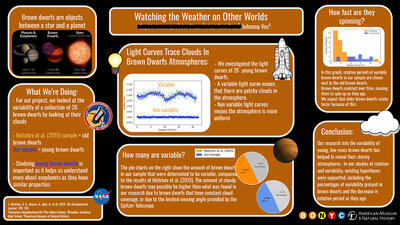
Research Question/Goal: How do sand clouds affect the detection of various chemical species in exoplanets atmospheres? Could these clouds be responsible for the diversity observed in exoplanets? The James Webb Space Telescope has observed a number of cloudy extrasolar atmospheres, allowing us to investigate the relation between the presence of sand clouds and the observability of different molecules throughout these atmospheres.
Skills students will build: Students involved in this project will learn how to inspect, visualize, and analyze astronomical data using the Python programming language and Jupyter notebooks. They will also develop teamwork and communication skills. The experience gained through this project is applicable to other astronomy-related fields as well as other areas of science. No prior research or programming experience is required to participate.
Along with presenting posters, SRMP students create final videos of their research which are presented at our Colloquium at the end of the program. Watch the final project videos from the Class of 2025.
Daniel Kim/© AMNH
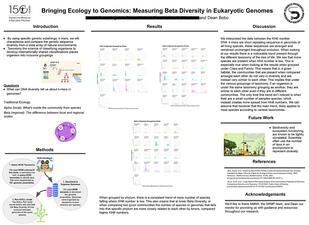
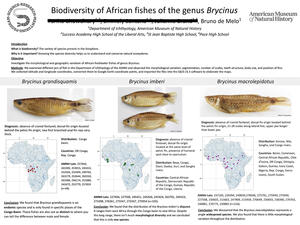
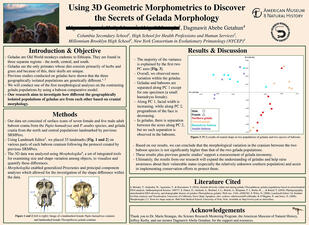
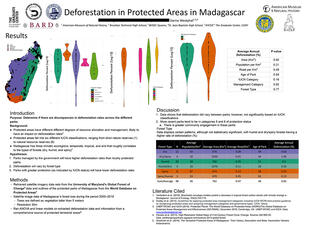
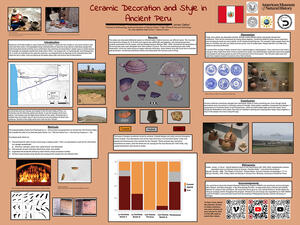
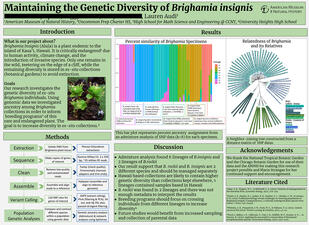
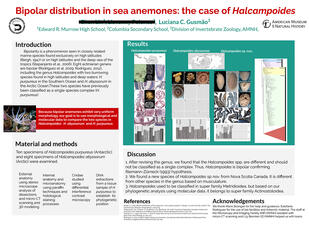
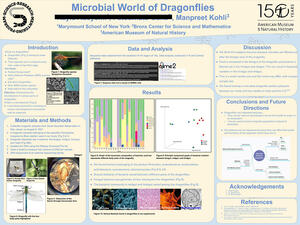
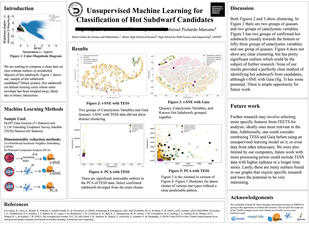
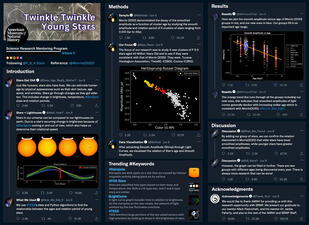
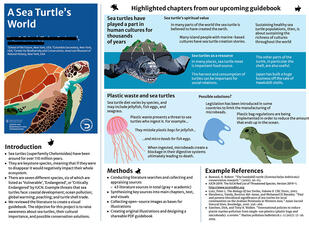
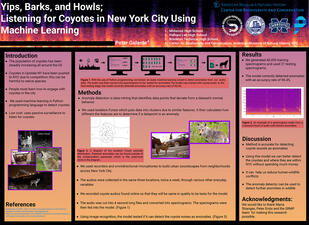
Take a look through the posters below showcasing SRMP projects from the last 5 years.
© AMNH