Laboratories
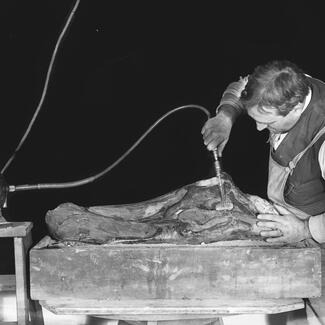
 Otto Falkenbach at work on giant turtle fossil, 1925.
 Elisabeth Rungius Fulda/© AMNH
Developing an efficient system for storing and preparing fossils was an essential first step in building a museum program in vertebrate paleontology. At the American Museum of Natural History, a flourishing program in mammalian paleontology, which had been established in 1891, was already overtaxed and so in 1898 the Museum set out to remodel the storage and work space for vertebrte paleontology.
The remodeled workspace for the Department of Vertebrate Paleontology was a major improvement for fossil preparation. Better lighting and ventilation in the new top-floor preparation lab made the work more pleasant, and elevated the visibility and prestige of fossil preparation.

By 1899 “state-of-the-art” systems in place included an overhead trolley system with chains and movable hoisting blocks attached to steel rails, which were used both to lift and move heavy blocks, and to suspend specimens while they were being fitted for mounting. The lab was wired for electricity, which provided power for reliable indoor illumination, and to power small electric motors, which in turn operated a multitude of essential tools.
A two-horsepower motor operated a large lathe, which drove a rotary diamond saw used for cutting stone and fossil bone; wheels for grinding and sharpening hand tools; a drill for boring specimens; and a small saw for cutting and splitting metal. A smaller motor ran the blower on a miniature gas blast furnace, which was used for heating and shaping metal armatures for mounting specimens and for tempering or reshaping metal tools.

By 1899 the Chicago’s Field Columbian Museum's lab space included a turning lathe, a workbench, and a sink with running water, but not enough space to work on the huge collection of Jurassic dinosaurs that had been collected in Colorado in 1900-01. New lab spaces added room for a closet, revolving worktables, and a skylight with sliding overhead curtains.
These Fossil Preparation resources were originally developed in 2007 with the support of the National Science Foundation (NSF).
