Historical Techniques
 © AMNH
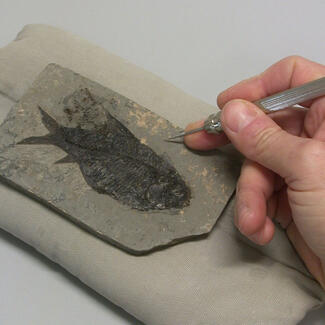
In the early days of collecting and study, fossil preparators worked exclusively with hand tools, especially awls and chisels. Bones were set up on sandbags for protection in a position favorable for working, and held firmly in place by means of several additional sandbags. A rotating stand or table was useful for keeping the working surface of the bone turned toward the light from a window.
Preparators removed hard matrix from the bones by chipping it away with a tedious, repetitive tapping of light shoemaker’s hammers on hardened steel chisels or awls for finer work. The work was exhausting for the preparator, and sometimes too hard on fragile specimens. The shock from the repeated blows could cause soft or brittle specimens to break. Applying hardening agents like shellac or gum arabic could prevent some of this damage, but little could be done to protect thin edges or other delicate structures.
Another problem was that a wide range of motion was required for wielding a hammer and chisel. On complicated bones with deep and intricate cavities, it was often impossible to find space for the blade of the chisel, an appropriate chisel angle to cleanly pluck matrix away without carrying a piece of fossil with it, or room to swing the hammer. This meant that early preparators were sometimes forced to deliberately break complicated fossils into pieces to remove matrix. But the greatest disadvantage of using hand tools was the slowness of the work.

To get around the problem of speed, particularly as the volumes of specimens collected began to grow rapidly, in the early 20th century preparators derived new techniques by adapting the technologies developed for large, commercial professions like dentistry. An electric dental lathe and dental engine was installed at the AMNH laboratory, while similar electric mallets and lathes were used at the Carnegie Museum. These motors were used to operate small grinding wheels, dental burs, or rotary brushes (wire or bristle). By using a flexible arm attachment, it was possible to get a greater range of motion and better access to cavities than could be achieved with ordinary hand tools.
Modified dental appliances were ideal for working on delicate skulls and teeth, but almost useless for the heavier work often involved in dinosaur paleontology. Using acids to soften hard matrix was one possible alternative, but there are disadvantages to this technique, including noxious fumes and the care required to ensure that the acid dissolved only the matrix and not the fossils. Modified sandblasting equipment was found to be very practical for cleaning matrix from large bone surfaces, but only where the matrix was considerably softer than the bone.
The introduction of pneumatic tools, especially the pneumatic hammer/chisel, was the one of the most important innovations made in fossil preparation. Paleontologist Elmer S. Riggs developed this technique at Chicago’s Field Museum early in 1903. To obtain a more controlled stroke, a special chisel-holding attachment was threaded onto the end of the pneumatic hammer. The attachment used a coil spring to absorb some of the impact and soften the blows of the hammer. Its square fitting also prevented the chisel from rotating. An air escape vent directed forward blew dust and fragments away from the working surface. Work with the pneumatic hammer was faster, more accurate, more versatile, and easier on both fossils and preparators.
These critical lab innovations–acid preparation, sand-blasting, and especially pneumatic hammers and chisels–dramatically improved the speed and quality of fossil preparation. A century later, these same tools and techniques are still the mainstays of modern fossil preparation.
These Fossil Preparation resources were originally developed in 2007 with the support of the National Science Foundation (NSF).
