Many stock up on food for their whole adulthood, throughout which they will never eat. Some climb trees in pursuit of arboreal snails. Others have gills like fish that allow them to dive for aquatic snails, whose shells they then use for protection like hermit crabs. In parts of Asia, a large mollusk called an apple snail has ravaged important crops such as rice, and firefly larvae are being explored as a potential form of biocontrol to protect those nations’ food supply.
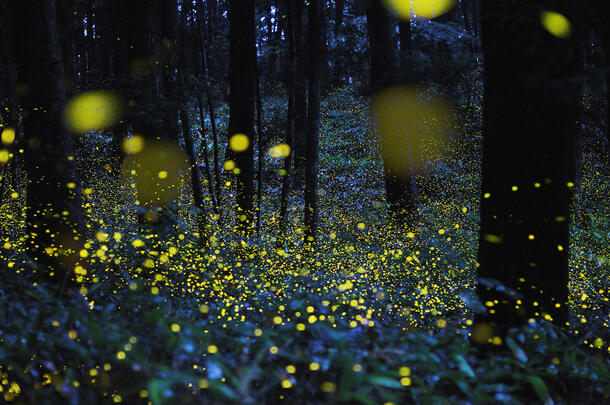
“Just think how poetic it could be if we had fireflies control snails in these agricultural systems as larvae and produce entertainment as a byproduct as adults,” says Marc Branham, an entomologist at the University of Florida.
Researchers are still investigating whether firefly numbers are dwindling. “If you ask anybody out there, they will tell you that it seems like there aren’t as many fireflies out now as there were 10 or 20 or 40 years ago,” explains Branham. The lack of data on older population numbers makes verifying their decline difficult. “But it’s pretty clear that there are some locations where people used to see many fireflies, and now you don’t see any.”
If fireflies are in fact in danger, humans’ own flair for things luminescent may be to blame. Neighborhoods that stay lit through the night may severely disrupt firefly mating behavior because the insects gauge when to flash based on how dark it is outside. One Florida species flashes for a precise 27 minutes each night, but without the correct lighting cue, these insects won’t understand when it’s time to start signaling and find a mate. Other factors, such as herbicides and pesticides, as well as habitat loss to urbanization, might be affecting the lightning bug as well.