Fossils of the Flaming Cliffs
Now Open
Included with any admission.
Floor 4, Vertebrate Origins corridor

Mick Ellison/© AMNH
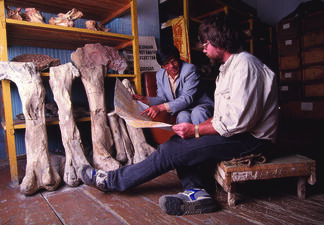
The new exhibition Fossils of the Flaming Cliffs celebrates the history of the Museum’s fossil excavations in the Gobi through large-scale photography and fossil casts of landmark discoveries.
Museum scientists have been traveling to the Gobi for over 100 years, searching for the beautifully preserved dinosaur, lizard, and mammal fossils that lie just below the sand. Their spectacular discoveries have transformed our understanding of ancient life.



See 12 fossil casts and 3-D prints of important fossils from the Gobi, including a nest of eggs with a tiny, just-hatched dinosaur, two oviraptorid dinosaurs with toothless beaks, and an extraordinary skeleton belonging to an early mammal whose lifestyle was similar to modern rodents.
This exhibition celebrates the memory of Mark Norell, the inaugural Macaulay Curator in the Museum’s Division of Paleontology.
Included with any admission.
Fossils of the Flaming Cliffs was generously supported by Jonathan Friedman in honor of Michael L. Friedman and Hyman R. Friedman.
A selection of the expeditions featured in the exhibit are part of the Margaret and Will Hearst Paleontological Expeditions to the Gobi Desert.
The leadership contributions of Katheryn P. and Thomas L. Kempner, Jr generously support the Museum’s Explore21 Initiative.