The Secret World of Elephants
African elephant herd© 2630ben/Shutterstock
Elephants use tools, mourn their dead, and communicate across long distances through ground vibrations. They have incredible spatial memories and sensing abilities. They have been essential to humans in work and war, and revered in culture and religion. Their populations are in danger.
The Secret World of Elephants brings visitors into a previously unseen, fascinating world of elephants through life-size models, compelling stories, and enlightening interactives, revealing just how much we are still learning about these intriguing animals.
Alvaro Keding/© AMNH
Key Questions
- How did elephants evolve, and who are their closest relatives?
- What unique adaptations help elephants survive?
- How are elephant and human behaviors similar?
- What role do elephants play in human cultures, and how can we help in their conservation?
[HAPPY PLAYFUL MUSIC]
[A group of visitors walk past the exhibit entrance. Text says “The Secret World of Elephants”.]
ROSS MACPHEE (Curator Emeritus, Department of Mammalogy): In The Secret World of Elephants, we've got the perfect animal for getting people involved with a whole range of stories-
[A group of adults sit together to watch a film about elephants.]
MACPHEE: about not only natural behavior-
[Elephants bathing in a pond.]
MACPHEE: — anatomy, relationships, all the usual — but also how-
[A small group of elephants walk alongside park rangers.]
MACPHEE: -these particular species interact with humans for good or ill over many thousands of years-
[Two elephants playing in the bushes.]
[Ross Macphee stands in front of a Savannah elephant model.]
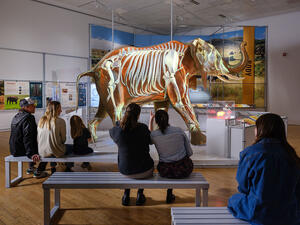
MACPHEE: This is a full-sized Savannah elephant from Africa and we're using it as a projection base in order to show you things about how the elephant is put together internally.
[Pan over animated projection playing on the side of a Savannah elephant model.]
MACPHEE: There's a projection of the muscles of the bones, the nerves. And on that basis, you can understand how it does what it does.
LAURI HALDERMAN (Sr. Vice President for Exhibition): I think people come to the exhibition because they're drawn to elephants-
[Lauri Halderman stands in a hallway at the Museum. A school group is passing by in the background.]
HALDERMAN: -they know what they are and elephants are very charismatic.
[A senior woman and a young boy read the label about elephant diet.]
HALDERMAN: But there's so much more to learn about elephants.
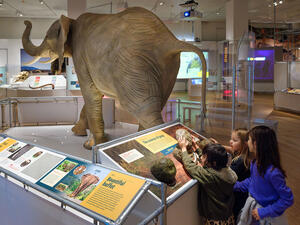
[A walking pair of visitors approach a large elephant model. A girl points to it in excitement.]
HALDERMAN: They’ll learn about how amazing their bodies are-
[MUSIC mellows out]
[Two women read off information panels about elephant migration and the ivory trade.]
[Wide shot of various visitors walking around the exhibition.]
HALDERMAN: -the important things they're doing in their ecosystems.
[A visitor flips open a model of elephant dung. Text reads “How does elephant poop help animals?”.]
HALDERMAN: At the American Museum of Natural History, I feel like the exhibitions that touch on-
[A large model of a “grass ball” on a scale to show how much elepahnts eat. Text reads “Big Eaters”.]
HALDERMAN: the natural science-
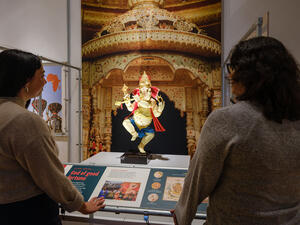
[A woman looks at a display case with elephant-themed figurines.]
HALDERMAN: -and the cultural stories together-
[Closeup on a figurine of a man riding an elephant.]
HALDERMAN: -are really a sweet spot for us.
[Closeup on a figurine of an elephant riding a scooter as it balances a ball on its trunk.]
HALDERMAN: I think when you come as a visitor, there's something for everyone.
[A child sticks an elephant magnet to a magnet wall.]
[Sean Decatur stands in front of a Savannah elephant model.]
SEAN DECATUR (President, American Museum of Natural History): The exhibition begins with what for biology is the central idea, which is evolution and evolutionary relationships.
[A man and young boy read from an info panel titled “A Long Story”.]
DECATUR: And so, where do elephants come from?
[Two flip panels, one of an African elephant, the other of a woolly mammoth. A hand flips up the woolly mammoth panel.]
DECATUR: How have elephants changed over time?
[A young woman looks at a panel with highlighting a skull model and a picture of a manatee. Text above reads “Unlikely relatives”.]
DECATUR: What are the relationships between other different types of species and elephants?
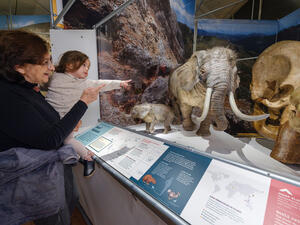
[A man points out a woolly mammoth model to a child.]
HALDERMAN: I think people have no idea how many-
[A man and woman read panels in a section of the exhibition titled “Evolution”.]
HALDERMAN: -extinct elephant relatives there are. They know mastodons-
[A man looks at a case with elephant bones inside. Text on the panel behind says “Mastodon vs. Mammoth".]
HALDERMAN: and mammoths, but boy-
[A group of visitors gather around a glass display with bones.]
HALDERMAN: is there a huge amount of diversity.
[Ross Macphee stands in front of a Savannah elephant model.]
MACPHEE: Can you imagine in your mind's eye a fully adult elephant that only weighs say, 400 or 500 pounds?
[A model of a dwarf elephant and its calf. A cast skull is behind it.]
MACPHEE: Can you imagine that same very small elephant having babies that would be the size of a very large cat? That's what we're looking at here-
[A family of four looks in amazement at a cast skull of a dwarf elephant.]
MACPHEE: -a dwarf elephant from the island of Sicily that used to live there-
[Closeup on the head of a model of a dwarf elephant.]
MACPHEE: -several hundred thousand years ago.
[An animation of bones and inner organs is projected onto the side of an African savannah elephant model.]
DECATUR: As a newcomer to AMNH, something that has been-
[A man and a woman watch as a child plays with an interactive infographic projected on a wall about elephant and human relationships.]
DECATUR: -very exciting for me to see is how-
[A model of a woolly mammoth shedding its winter coat.]
DECATUR: -collaborations between-
[A touchable model of an elephant tusk.]
DECATUR: -artists and engineers and designers and scientists-
[An animation of an elephant’s gestation period is projected onto the side of an African savannah elephant model.]
DECATUR: -and conservation experts-
[A woman walks past a wall panel titled “Protecting Elephants”.]
DECATUR: -can result in a comprehensive-
[A child turns a wheel that’s part of a light-up interactive. A label nearby reads “How the ears cool the body”.]
DECATUR: -dynamic exhibit.
[Brett Peterson stands in front of a screen with a mini-game.]
BRETT PETERSON (Director of Media and Interactives): I think a lot of people know that elephants are smart but we really wanted to highlight these complex social behaviors between elephants-
[A woman and a group of young girls stand playing at two game stations.]
PETERSON: -and how they interact with each other.
[A group plays a pop quiz. They all smile after guessing the answer.]
MACPHEE: Communication is everything. They spend a lot of time interacting with each other by sound, by touch, by gesture with their trunks.
[A trio of kids stand at another game station.]
PETERSON: This piece in particular, “Can You Speak Elephant?”, is an opportunity to explore that.
[A man and a young boy start a mini-game. A collage of elephant photos are on a screen that says “Can You Speak Elephant?”.]
PETERSON: You can see different elephant behaviors and learn about them and try to guess what they're doing in their own environments.
[A few visitors sit while watching a film.]
HALDERMAN: The exhibition has a film called Shaba that's about an organization in Kenya in which local communities-
[Caretakers feed a bottle to a baby elephant.]
HALDERMAN: -adopt orphaned elephants-
[A caretaker examines the bottom of a baby elephant’s foot.]
HALDERMAN: -raise them, and rewild them. It's not only amazing work-
[Baby elephants run playfully across a field.]
HALDERMAN: -but it's so heartwarming and it's good for both the elephants and-
[A woman presses her forehead against that of a baby elephant after feeding it.]
[PLAYFUL MUSIC BUILDS UP]
HALDERMAN: -the local Samburu women who do the work.
[A group of teens gather to look over a fence.]
[A caretaker calls to a baby elephant that comes running to her and latches onto the feeding bottle being held out.]
DECATUR: This exhibit addresses ways in which elephants are being threatened in their natural habitats and how-
[Sean Decatur stands in front of a Savannah elephant model.]
DECATUR: -human interactions with elephants are negatively impinging on the survival of elephants. And so, we hope visitors take away new insights into the science but also take away a deeper understanding to the importance of conservation, to the survival of elephants.
[MUSIC DRIFTS OFF]
[Credits roll.
The Secret World of Elephants is organized by the American Museum of Natural History, New York (amnh.org).]
Request More Information
Contact us to request availability for hosting this traveling exhibition.
The Secret World of Elephants is organized by the American Museum of Natural History, New York (amnh.org).